

How to Keep Small Batch Coffee Fresh
Table of Contents
- Why Small Batch Coffee Demands Different Storage
- Understanding Coffee Freshness: Roast Date and Shelf Life
- The Best Coffee Storage Container for Small Batches
- How to Store Ground Coffee for Maximum Freshness
- Your Step-by-Step Small Batch Storage Routine
- Can You Freeze Coffee Beans Without Losing Quality
- Storage Conditions That Protect Your Investment
- Common Storage Mistakes That Steal Freshness
- Frequently Asked Questions
Last Updated: October 17, 2026
Why Small Batch Coffee Demands Different Storage
Small-batch coffee arrives fresher, with delicate flavor compounds still developing. The window for peak freshness is shorter, so storage mistakes cost you more.
You're investing in beans roasted days or weeks ago, not months. The roaster prioritized flavor over shelf stability; your job is to preserve it.
At Wild Mustang Roasters, we've watched customers open bags expecting bold, complex flavors only to find flat, stale coffee because they stored it wrong.
Small batches also mean smaller quantities: you might finish a half-pound in two weeks instead of a month. Your goal is to keep small batch coffee fresh at its peak for days or weeks while you drink it.
Understanding Coffee Freshness: Roast Date and Shelf Life
Roast date is the only date that matters. Not the purchase date, not the best-by date. The roast date tells you exactly how old your beans are.
Coffee peaks 3-7 days after roasting, when flavors are bright, complex, and alive. After two weeks you'll notice the difference; after four, most small-batch coffees taste flat and bitter.
Ground coffee expires faster than whole beans. Once you grind, oxygen rushes in and breaks down flavors; ground coffee stays fresh for 30 minutes to an hour.
Whole beans last longer because the bean protects the interior, staying fresh for 2-4 weeks if stored correctly. But once air touches the surface, oxidation accelerates.
The Best Coffee Storage Container for Small Batches
The container you choose determines how fast your coffee goes stale. Not all airtight containers are equal, and for a small batch the stakes are higher: you have less coffee to absorb a mistake.
The four criteria that actually matter
Judge any container against four criteria, in this order:
- Seal quality. The lid must create a gasket-tight seal every time you close it. Rubber gaskets, silicone rings, and locking clamps pass. Snap-on plastic lids and friction-fit lids usually fail after a few weeks of use.
- Opacity. The material must block light completely. Opaque ceramic, dark-tinted glass, and matte metal pass. Clear glass and clear plastic fail unless you store them inside a dark cabinet.
- Capacity match. The container should hold roughly your weekly supply, not your monthly supply. Extra headspace means extra oxygen sitting against the beans.
- Ease of use. A container you dread opening gets left open. A container with a stiff latch or a lid that needs two hands gets skipped during a rushed morning brew.
Comparing the realistic options
Opaque airtight canisters (ceramic or matte metal). Best overall for daily-use portions. They block light, seal with a gasket, and come in sizes from about 6 to 16 ounces.
Original valve bags. Excellent for the reserve portion you are not opening yet.
Clear glass jars with gaskets. Acceptable only inside a dark cabinet. The gasket seals well and glass doesn't absorb odors.
Vacuum containers with a pump. Useful for the reserve portion and pre-portioned freezer bags, removing more air than a standard lid.
Snap-lid plastic containers. The weakest option for long storage: cheap and stackable, but the seal degrades and plastic holds odors. Use them only for short-term transport.
Sizing the container to a small batch
A typical small-batch bag is 6 to 12 ounces; at 0.5 to 1 ounce per day, it lasts one to three weeks. Don't buy one large container for the whole bag. Buy two small ones: one for the week's supply, one for the reserve. Too large is worse than slightly too small, because empty space fills with oxygen every time you open the lid.
How to Store Ground Coffee for Maximum Freshness
Ground coffee is a time-limited product with a small window at its best.
Store ground coffee in an airtight container in a cool, dark place. Use it within one week of opening. Two weeks is the absolute maximum.
Grinding increases surface area dramatically, which means faster oxidation. That's why supermarket pre-ground coffee tastes dull: it's been oxidizing for weeks or months.
If you buy ground coffee from Wild Mustang Roasters, grind it fresh at home instead. A basic burr grinder costs $30-50 and transforms your coffee.
If you must buy pre-ground, use it within days and store it in the coldest, darkest corner of your kitchen. Airtight containers help, but time is your real enemy.
Your Step-by-Step Small Batch Storage Routine
This is the routine that will keep small batch coffee fresh and tasting like the roaster intended. Follow it every time you open a bag.
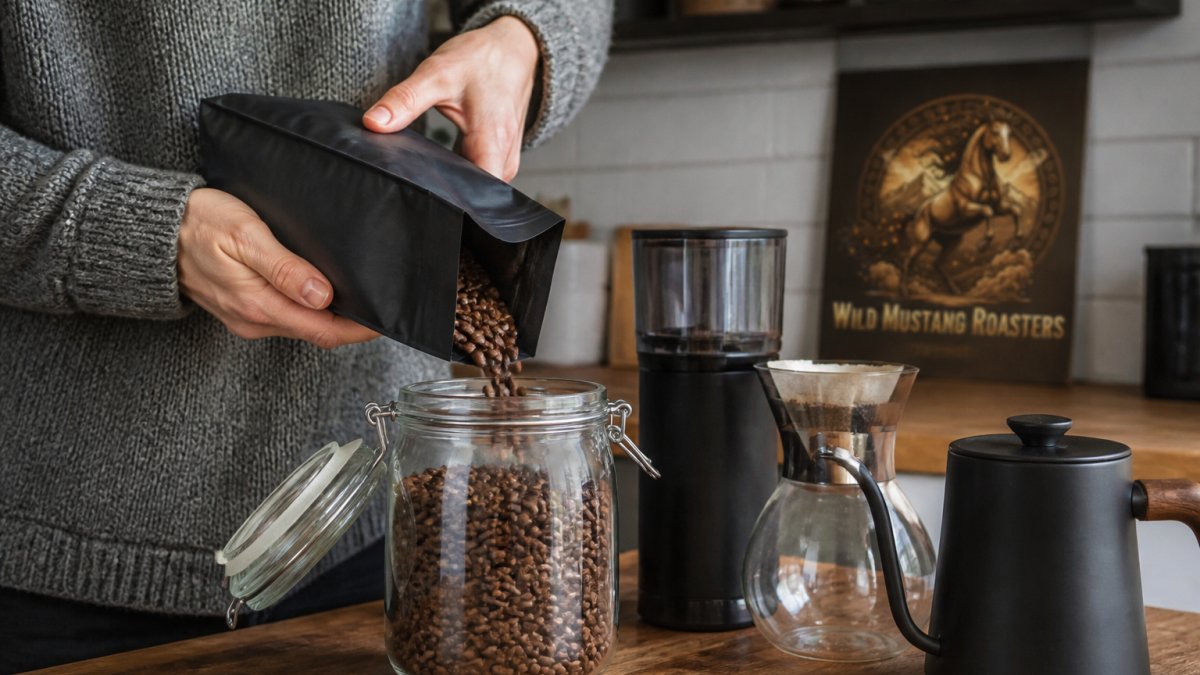
Opening and portioning your coffee
Step 1: Check the roast date. Verify how old the beans are, then set a calendar or phone reminder for four weeks out. This is your freshness deadline.
Step 2: Portion your beans. Decide how much you'll drink this week: for most people, 0.5 to 1 ounce per day from a typical 6-12 ounce bag.
Pour your week's supply into a small airtight container. Keep the rest sealed in the original bag or a larger airtight container.
Step 3: Grind only what you'll brew today. Grind fresh before every brew session: once a day if you brew once, twice if you brew twice.
This takes two minutes. It's the single biggest factor in taste.
Sealing and labeling for traceability
Step 1: Seal your containers completely. Make sure the lid is tight. If it's a bag, fold it down and use a clip or clothespin. No air gaps.
Step 2: Label everything. Write the roast date and the date you opened the bag on a piece of tape. Stick it on the container.
Example: "Roasted 10/1/26 | Opened 10/8/26"
Step 3: Store in the coolest spot. Find the darkest, coolest corner of your kitchen: not above the stove, next to a window, or above the refrigerator where heat rises.
A pantry shelf or a kitchen cabinet away from appliances works well.
Label your containers even if you think you'll remember. You won't. A label takes five seconds and saves you from brewing stale coffee.
Can You Freeze Coffee Beans Without Losing Quality
Yes. Freezing works if you do it right, and for a small batch it's often the smartest move: protect the reserve portion while you drink the daily-use portion. The key is avoiding repeated thawing, which is where most people ruin their beans.
Portion before you freeze, not after
Freeze only what you will not drink within two weeks. Divide the reserve into portions sized to how fast you will use them. A practical pattern is one portion per week of consumption: if you drink 0.5 to 1 ounce per day, portion in 3.5 to 7 ounce increments. Each portion should be small enough to use completely once thawed.
Use a vacuum sealer or a heavy-duty freezer bag with as much air pressed out as possible. Label each portion with the roast date and the freeze date. A common pattern is to freeze six small one-week portions instead of one large bag, so you open the freezer once a week rather than once a day.
The thawing routine that protects flavor
When you want to use a frozen portion, remove one container and let it thaw at room temperature for about 30 minutes before grinding. Do not open the container while it is still cold, because condensation forms when frozen beans meet warm air and that moisture damages flavor. Once thawed, grind and brew immediately. Do not thaw and refreeze.
A second approach some practitioners use is grinding the frozen beans directly without thawing, which avoids the condensation window entirely. It works best with a burr grinder that handles cold beans without stalling. Try both and see which gives you a better cup.
How long frozen coffee actually stays good
Frozen beans stay fresh for up to three months but are best within the first month. Cold slows the chemical reactions that make coffee stale but doesn't stop them; after a month, even frozen coffee declines, faster for ground than whole beans.
What not to freeze
Do not freeze coffee you plan to open daily. Every time you open a frozen container, warm air enters and condensation forms. Freeze only the reserve portion, and keep the daily-use portion in an airtight container at room temperature.
Storage Conditions That Protect Your Investment
Your storage environment determines how fast coffee goes stale. Four factors matter: temperature, light, humidity, and air exposure.
Temperature, light, and humidity control
Temperature: Keep coffee between 50°F and 70°F. Room temperature is fine. Avoid anywhere hot.
Cold slows oxidation. A pantry stays cooler than a kitchen counter.
Light: Light breaks down flavor compounds. UV rays accelerate the process. Store in a dark container or a dark place.
If your container is clear, put it in a cabinet.
Humidity: Moisture causes mold and clumping. Keep coffee away from the sink and dishwasher. Don't store in a bathroom.
Your kitchen pantry is ideal. It's cool, dark, and dry.
Air exposure: Oxygen is the enemy. Seal containers completely. Fold bags down tight.
A vacuum sealer is optional but helpful. It removes excess air from small portions before freezing.
Common Storage Mistakes That Steal Freshness
Most people make one or two of these mistakes. Knowing them helps you avoid them.
Storing in the original bag without resealing. The bag protects your coffee, but only if it's sealed.
Using clear glass containers. You can see your beautiful beans, but light is destroying them. Opaque containers protect better.
Keeping coffee on the counter. Countertops are warm and bright. Cabinets are cooler and darker.
Grinding days in advance. Ground coffee oxidizes in hours.
Freezing the entire bag. When you freeze a large bag and thaw it repeatedly, condensation ruins the beans.
Ignoring the roast date. Coffee without a roast date is probably old. Always buy from roasters who print it.
The three biggest mistakes: storing in clear containers, grinding in advance, and ignoring roast dates. Avoid these and your small-batch coffee stays fresh.
Small-batch coffee deserves storage that matches its quality. Subscribe to our emails to get roasting tips, freshness guides, and exclusive access to limited roasts designed to inspire your morning ritual.
Frequently Asked Questions
How long do coffee beans stay fresh after roasting?
Small batch coffee beans remain at peak freshness for 2-4 weeks after the roast date, with noticeable flavor decline after 4 weeks. Whole beans last longer than ground coffee because grinding exposes more surface area to oxygen. Check the roast date on your bag, this matters far more than the purchase date. Ground coffee should be used within 1-2 weeks for best results.
What is the best coffee storage container for small batches?
An airtight, opaque container is your best choice. Glass canisters with rubber seals or stainless steel containers with tight-fitting lids both work well. Avoid clear containers that expose beans to light. If you prefer to keep coffee in its original bag, choose bags with one-way valves that allow CO2 to escape while blocking oxygen and moisture from entering.
Can you freeze coffee beans without losing quality?
Yes, freezing works for small quantities you won't thaw repeatedly. Freeze beans in an airtight, moisture-proof container or vacuum-sealed bag in portions you'll use within one brewing session. Thaw completely before opening to prevent condensation. Avoid multiple freeze-thaw cycles, which degrade flavor. Freezing extends shelf life 3-6 months but slightly dulls the bright notes of fresh-roasted coffee.
How should I store ground coffee to keep it fresh?
Ground coffee loses freshness faster than whole beans because grinding increases surface area exposed to oxygen. Store it in an airtight, opaque container away from heat, light, and moisture. Keep it in a cool, dark place like a pantry or cupboard, never above the stove or near a window. Use ground coffee within 1-2 weeks, and grind whole beans just before brewing for maximum flavor retention.