

Is a Burr Grinder Worth It for Home Coffee?
Table of Contents
- Burr vs Blade Grinder: What Actually Matters
- Why Grind Consistency Affects Your Cup
- Coffee Grind Size Chart and Brewing Methods
- The Benefits of Freshly Ground Coffee
- Noise, Static, and Practical Concerns
- Is a Burr Grinder Worth It for Your Brewing Style?
- Getting Started: Burr Grinder Basics for Beginners
- Frequently Asked Questions
Last Updated: September 28, 2026
Burr vs Blade Grinder: What Actually Matters
A burr grinder worth it for home coffee brewing comes down to one fundamental difference: consistency. Burr grinders crush beans between two surfaces, either conical or flat burrs, producing uniform particle sizes. Blade grinders, by contrast, chop beans with a spinning blade, creating an uneven mix of fine powder and large chunks. That inconsistency matters because coffee extraction depends on uniform grind size. When particles vary wildly, some over-extract (becoming bitter) while others under-extract (tasting sour). You end up with a cup that tastes muddled instead of clear.
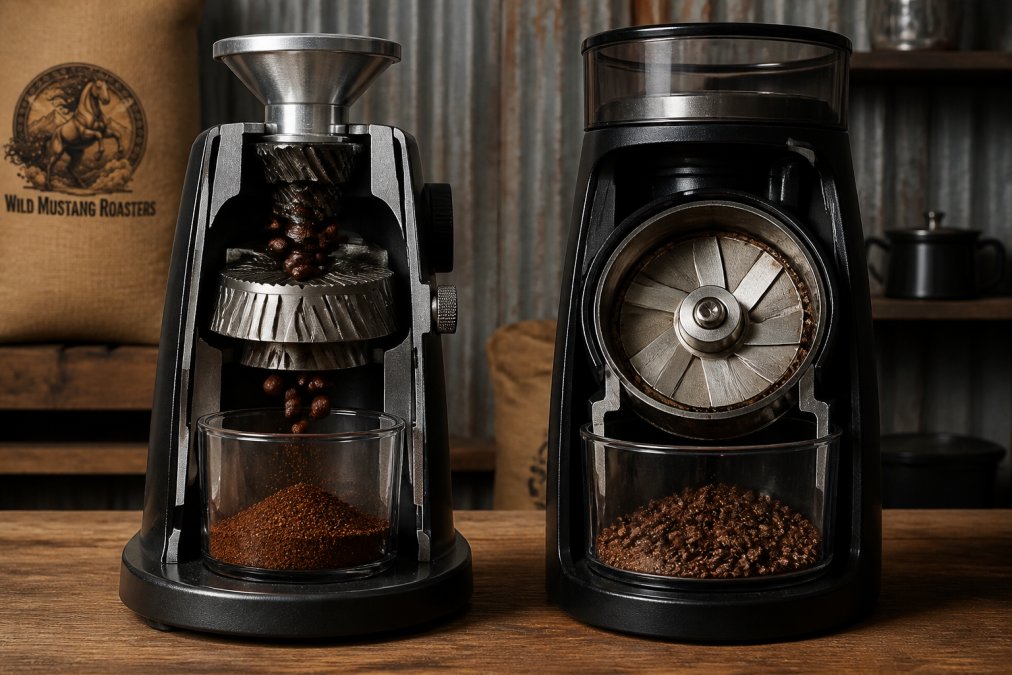
The practical impact is immediate. With a burr grinder, you can dial in a specific grind size and expect consistency from one brew to the next. A blade grinder requires you to guess, shake it longer, maybe you get finer grounds, maybe you get dust. Most home brewers find that switching to a burr grinder eliminates the guesswork and produces noticeably cleaner, brighter coffee within the first few uses.
That said, blade grinders have one advantage: price. They cost less upfront. But if you're already buying premium coffee, the kind Wild Mustang Roasters roasts in small batches, grinding it unevenly wastes the investment. A burr grinder is worth it precisely because it respects the coffee you're buying.

Why Grind Consistency Affects Your Cup
Grind consistency directly controls how water interacts with coffee grounds. When particles are uniform, water flows through them at a predictable rate. When particles vary, water finds paths of least resistance, rushing past some grounds while getting stuck in others. The result is uneven extraction.
Think of it this way: a 200-micron particle (very fine) extracts much faster than a 800-micron particle (coarse). In a blade-ground batch containing both, the fine particles over-extract and release bitter compounds while the coarse particles barely release anything. You taste the bitterness but miss the sweetness and complexity that proper extraction brings out.
Burr grinders eliminate this problem by producing a narrow range of particle sizes. A medium grind from a burr grinder means most particles fall within a defined range, say, 600-800 microns, so they all extract at roughly the same rate. This uniformity is what coffee professionals call grind consistency, and it's non-negotiable for quality brewing.
The flavor difference is substantial. Coffee that's properly extracted tastes bright, balanced, and clean. The same beans ground unevenly taste flat, bitter, or sour depending on which particles dominate the cup. Many home brewers report that simply switching to a burr grinder improves their coffee more than any other single change.
Coffee Grind Size Chart and Brewing Methods
Different brewing methods require different grind sizes because they use different contact times between water and grounds. A burr grinder worth it for your setup depends partly on whether it can produce the grind size your brewing method needs.
| Brewing Method | Ideal Grind Size | Particle Range | Contact Time |
|---|---|---|---|
| Espresso | Very Fine | 200-400 microns | 25-30 seconds |
| Pour-Over | Medium-Fine | 400-600 microns | 3-4 minutes |
| Drip Coffee | Medium | 600-800 microns | 5-10 minutes |
| French Press | Coarse | 800-1200 microns | 4 minutes |
| Cold Brew | Very Coarse | 1200+ microns | 12-24 hours |
The reason grind size matters this much is extraction yield. Finer grounds have more surface area, so water extracts flavor compounds faster. Coarser grounds extract slower. If you use a fine grind in a French press (which has a long contact time), you over-extract and get bitter, muddy coffee. If you use a coarse grind in espresso (which has a short contact time), you under-extract and get sour, thin coffee.
A burr grinder lets you match grind size to your brewing method. A blade grinder cannot, it gives you whatever inconsistent texture it produces. If you brew multiple ways (espresso one day, pour-over the next), a burr grinder becomes essential because you need precise control over particle size.
The Benefits of Freshly Ground Coffee
Freshly ground coffee tastes dramatically better than pre-ground coffee because grinding exposes the inside of the bean to air, triggering oxidation and aroma loss. Within 15 minutes of grinding, you've lost much of the volatile compounds that make coffee taste complex and bright. Within an hour, the flavor has degraded noticeably.
Pre-ground coffee sits in a bag or can for weeks or months, losing aroma and flavor the entire time. By the time you brew it, you're working with stale, one-dimensional coffee. The difference between fresh-ground and pre-ground is often more dramatic than the difference between good beans and mediocre ones.
This is where a burr grinder worth it becomes obvious: it lets you grind immediately before brewing. You capture the full flavor potential of the beans. Wild Mustang Roasters roasts coffee in small batches specifically so you get fresher beans to start with. Pairing fresh beans with a burr grinder and grinding right before brewing creates a compounding effect, you're not wasting premium coffee by letting it stale or grinding it unevenly.
Many home brewers notice that switching to fresh-ground coffee (using a burr grinder) has a bigger impact on cup quality than switching to a different brewing method.
Noise, Static, and Practical Concerns
Burr grinders are louder than blade grinders because the burrs rotate at high speed and create friction. A typical burr grinder produces 80-90 decibels, roughly the sound of a blender or heavy traffic. If you brew coffee at 6 AM while others sleep, this matters. Some burr grinders are quieter (around 75-80 dB), but silence isn't an option with this technology.
Is a Burr Grinder Worth It for Your Brewing Style?
A burr grinder worth it depends on what you brew and how much you value cup quality. If you make drip coffee once a day and don't mind inconsistent flavor, a blade grinder might be "good enough." But if you care about taste, and if you're buying premium small-batch coffee from Wild Mustang Roasters, you probably do, a burr grinder is non-negotiable.
Getting Started: Burr Grinder Basics for Beginners
Start by understanding the two main burr types: conical and flat. Conical burrs are cone-shaped and nest inside each other. Flat burrs are two parallel discs. Conical burrs are more forgiving for beginners because they're less sensitive to grind-size adjustments and produce slightly less heat. Flat burrs are more precise and preferred by espresso enthusiasts, but they're louder and require more care.
The Dialing-In Process:
-
Start with a baseline grind size. For drip coffee, begin at a medium setting (usually marked as "5" or "6" on a numbered dial, or "medium" on a labeled grinder). For pour-over, start slightly finer ("4" or "5"). For French press, start coarser ("7" or "8"). Grind enough beans for one full brew.
-
Brew and taste. Make one cup using your normal brewing method. Pay attention to how the coffee tastes: Is it sour and thin? Is it bitter and muddy? Is it balanced and clean?
-
Adjust based on flavor. If the brew tastes sour or thin (under-extracted), grind finer, move your dial one or two clicks toward the finer end. If it tastes bitter or muddy (over-extracted), grind coarser, move your dial one or two clicks toward the coarser end. Make only one small adjustment at a time. Grind a fresh batch and brew again.
-
Repeat until balanced. Continue this cycle until the coffee tastes clean, balanced, and bright. You should taste sweetness and complexity, not just bitterness or sourness. This typically takes 3-5 adjustment cycles.
-
Write down your setting. Once you find the sweet spot, note the dial position or number. This becomes your baseline for that brewing method and coffee origin. Different coffees may need slight adjustments (lighter roasts often need slightly finer grinds; darker roasts slightly coarser), but you now have a starting point.
Common Beginner Mistakes:
- Making too large an adjustment. Moving your dial by 5 clicks instead of 1-2 overshoots the target and makes it harder to find the sweet spot. Small adjustments compound.
- Changing multiple variables at once. If you adjust grind size AND brewing time AND water temperature in the same cycle, you won't know which change fixed the problem. Adjust one variable per brew.
- Not waiting for the grinder to stabilize. After you adjust the grind size dial, the first few grams of coffee may still reflect the old setting. Discard the first small handful and then grind your full dose.
- Assuming one grind size works for all coffees. A light roast from a single-origin farm may need a finer grind than a dark espresso blend. Be willing to adjust slightly for different coffees.
Establishing a Routine:
Frequently Asked Questions
What's the real difference between a burr grinder and a blade grinder?
A burr grinder crushes beans between two rotating surfaces, creating uniform particle sizes. A blade grinder chops beans with spinning blades, producing inconsistent pieces. This matters because uniform grind size ensures even extraction, the process where hot water pulls flavor compounds from coffee. Inconsistent sizes lead to some particles over-extracting (bitter taste) and others under-extracting (sour taste). For most brewing methods beyond instant coffee, a burr grinder delivers noticeably better flavor.
Do I need a burr grinder for drip coffee makers?
Drip coffee makers are forgiving with grind size, but they still benefit from consistency. A burr grinder ensures your medium grind is truly medium throughout the batch, improving extraction and reducing bitterness. Blade grinders work for drip, but you'll notice the difference in cup quality if you've had properly ground coffee before. The investment pays off if you brew drip daily and care about flavor.
How long does freshly ground coffee stay fresh?
Whole beans stay fresh for 2-4 weeks after roasting when stored in an airtight container away from light and heat. Ground coffee oxidizes much faster, within 15-30 minutes of grinding, it begins losing aroma and flavor compounds. This is why grinding just before brewing makes a measurable difference in taste. If you grind in bulk, store ground coffee in an airtight container and use it within a few days for best results.
Are burr grinders worth the cost for casual home brewers?
If you brew coffee 3+ times per week and care about flavor, yes. A quality burr grinder costs $40-150 and lasts years, making the per-cup cost negligible. The taste improvement is immediate, less bitterness, better clarity of origin flavors, and more consistent results. If you're casual or prefer convenience over flavor, a blade grinder or pre-ground coffee may suit you. But if you've invested in quality beans like Wild Mustang's single-origin coffees, a burr grinder unlocks their full potential.