

Is a Tea Infuser the Best Way to Brew Loose Leaf Coffee?
Last Updated: October 24, 2026
Quick Summary
A French press, pour-over cone, or filter teapot brews better loose leaf coffee than a tea ball, and grind size decides which works best. Coarse grounds suit French presses and filter teapots, while medium grounds suit pour-over cones.
- A tea ball is the worst coffee option: too small a chamber and it clogs quickly.
- A basket infuser should hold at least 15 grams of coarse grounds.
- Preheat your infuser with hot water for 30 seconds before adding grounds.
- Start with a ratio of roughly 1:15 coffee to water by weight.
- If the cup turns harsh, coarsen the grind before changing anything else.
Table of Contents
- What Equipment Actually Works for Loose Leaf Coffee
- Can You Put Coffee in a Tea Infuser?
- Brewing Coffee With a French Press: The Most Forgiving Method
- Coffee Brewing Without a Coffee Maker: Pour-Over and Filter Teapots
- Portable Coffee Brewing Equipment for Camp and Travel
- Cost, Durability, and Replacement Parts
- Pick Your Brewer and Start With a Ratio That Works
- Frequently Asked Questions
What Equipment Actually Works for Loose Leaf Coffee
The short answer: a French press, a pour-over cone, or a filter teapot will brew better loose leaf coffee than a tea ball, and grind size decides which of them works best.
Loose leaf coffee is whole-bean coffee ground for full-immersion or filter brewing rather than packed into a pod, so the water contacts every particle and you control the dose. The equipment matters less than most buyers think.
Below, we break down each brewer by how it handles coarse grounds, how easy it is to clean, and what it costs to keep running.
Grind Size Comes First
Grind size is the first decision, not the equipment. Coarse grounds, roughly the texture of sea salt, suit French presses and filter teapots because the mesh or paper can hold them back. Fine grounds slip through mesh and turn a clean cup gritty.
A common mistake is buying a brewer first and then trying to make the grind fit it. A burr grinder produces consistent size, which is why whether a burr grinder is worth it for home brewing is the question worth answering before you spend on hardware.
Can You Put Coffee in a Tea Infuser?
Yes, you can put coffee in a tea infuser, but the result depends almost entirely on grind size and chamber volume. A tea ball packed with coarse grounds brews a weak, sour cup because water cannot circulate through the tight mass; a wide basket infuser with room for the grounds to expand brews a cup that is closer to a French press than most people expect.
Tea Balls, Basket Infusers, and Mesh Strainers Compared
A tea ball is a perforated container, usually two hemispheres on a chain. It is the worst option for coffee. The chamber is small, so you cannot use enough grounds for a proper ratio, and the fine mesh clogs with coffee oils within a few brews.
Basket infusers are the strongest infuser option for coffee. They sit inside a mug or teapot and give the grounds room to expand, which is the whole game with full immersion.
Mesh strainers are a different tool. You brew loose in a jug or mason jar, then pour through the strainer into your cup. It works, it is cheap, and it is messy if you are not careful.
| Infuser type | Best for coffee? | Main drawback |
|---|---|---|
| Tea ball | No, too small | Weak cup, clogs quickly |
| Basket infuser | Yes, coarse grind | Needs a wide mug |
| Mesh strainer | Yes, as a pour filter | Extra vessel to wash |
Coffee Brew Performance: Infuser vs. French Press vs. Pour-Over
The gap most tea-oriented guides leave is a direct coffee comparison. Here is how the main setups behave on the four attributes that matter, based on common brewing practice rather than lab testing:
- Clarity: Pour-over with a paper filter is the cleanest cup because paper catches fines and most oils. A basket infuser is next, then a French press, which is the cloudiest because its mesh lets oils and fine particles through.
- Body: French press wins on body because full immersion and metal filtration retain oils and suspended solids. Basket infusers land close behind. Pour-over is lighter and more tea-like in mouthfeel.
- Sediment: Pour-over leaves almost none. A basket infuser leaves a little grit at the bottom of the mug. A French press leaves a noticeable sludge unless you decant promptly and avoid pressing hard.
A practical rule: if you want the cleanest cup and do not mind standing at the counter, choose pour-over. If you want body and forgiveness, choose a French press. If you want a single mug with minimal gear and you already own a wide basket infuser, use it with a coarse grind and accept a little sediment.
If you are weighing these shapes against each other, our guide to the features that matter in a tea infuser covers lid fit, mesh gauge, and handle design in detail.
Brewing Coffee With a French Press: The Most Forgiving Method
Brewing coffee with a French press is the most forgiving method for loose leaf coffee because the mesh filter tolerates a slightly uneven grind and the full immersion pulls out body that paper filters strip away.
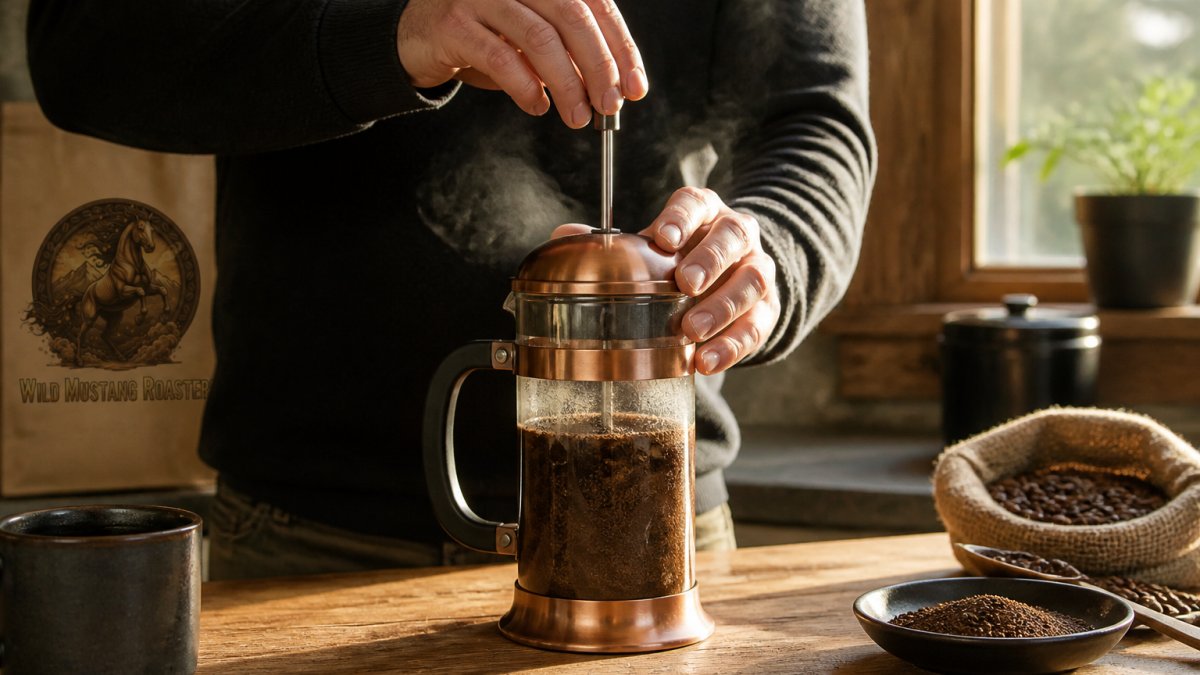
Here is the method we would use:
- Heat water to just off a boil, then let it sit a moment.
- Add coarse grounds to the carafe.
- Pour water over the grounds and stir once.
- Fit the lid with the plunger raised and wait four minutes.
- Press slowly and pour immediately.
Watch out: pressing fast forces fine particles past the mesh and leaves grit in the cup. Slow, steady pressure is the difference between clean and cloudy.
Our 34oz French Press in copper and stainless steel ships with spare filter screens and a cleaning brush, which matters because the screen is the part that wears out.

Coffee Brewing Without a Coffee Maker: Pour-Over and Filter Teapots
Coffee brewing without a coffee maker comes down to two reliable setups: a pour-over cone with paper filters, or a filter teapot that traps grounds behind a metal or ceramic screen. Both give you a clean cup and both are easy to clean.
Pour-over rewards attention. A steady circular pour and a short bloom keep the bed even, and the paper filter catches everything, so grind size is more forgiving than with mesh.
A filter teapot is the low-effort version. For technique and timing, our guide to brewing pour-over coffee at high altitude explains why water temperature and pour speed change at elevation.
Portable Coffee Brewing Equipment for Camp and Travel
Portable coffee brewing equipment splits into two camps: devices that need hot water and a vessel, and methods that need almost nothing. A small French press travels well if it is glass-lined and padded. A collapsible pour-over cone weighs next to nothing.
For off-grid trips, the no-equipment methods are worth knowing. We cover the variations in our guide to cowboy coffee alternatives for coffee lovers.
A stovetop espresso maker is the other travel option. Our stovetop espresso maker has an all-stainless induction base, so it works on the camp stove and the kitchen range alike, and it is compact enough to pack.

Cost, Durability, and Replacement Parts
The cheapest brewer is rarely the cheapest ownership. A tea ball costs almost nothing and lasts about as long as the hinge holds. A stainless basket infuser costs more and lasts years.
Durability comes down to three things:
- Metal thickness on baskets and screens, since thin mesh dents and stops sealing
- Glass quality on carafes, where borosilicate handles heat better than ordinary glass
- Replaceable parts, because a brewer you can repair beats one you throw away
Cleaning is part of the cost. Coffee oils go rancid on mesh and in spouts, and a brewer you dread washing is a brewer you stop using. Rinse immediately, use a brush on the screen, and skip the dishwasher for anything with a glass carafe.
Pick Your Brewer and Start With a Ratio That Works
Start with a ratio of roughly 1:15, coffee to water by weight, and adjust from there. That means about 20 grams of coarse grounds for 300 grams of water, which lands near a standard mug. Weigh it once or twice and you will stop needing the scale. The bigger gap in most loose-leaf guides is that they stop at one ratio and never connect grind size, water temperature, and brew time to the brewer you actually chose.
Starting Parameters by Brewer
| Brewer | Grind | Coffee : water | Water temp | Brew time |
|---|---|---|---|---|
| French press | Coarse, sea-salt texture | 1:15 by weight | Just off a boil, about 200-205°F | 4 minutes, then press slowly |
| Basket infuser | Coarse | 1:16 | About 200°F | 4-5 minutes |
| Pour-over cone | Medium, like table salt | 1:16 | About 200-205°F | 2-3 minutes total, including bloom |
| Filter teapot | Coarse to medium | 1:16 | About 200°F | 4 minutes |
These are starting points, not rules. A 1:15 ratio in a French press gives a heavier cup; move toward 1:17 if it tastes muddy. A pour-over at 1:16 is a good baseline; go to 1:15 for more strength or 1:17 for a lighter cup.
Grind Size and Filter Compatibility
Grind size is the variable that decides whether a brewer works at all. Coarse grounds, roughly the texture of sea salt, suit French presses and filter teapots because the mesh or screen can hold them back.
A common mistake is buying a brewer first and then trying to make the grind fit it. Work the other way. If you already own a blade grinder, expect uneven particles and some sludge in the cup.
How to Adjust When the Cup Is Off
Bitterness usually comes from over-extraction, not from the coffee itself. If the cup turns harsh, coarsen the grind before you change anything else. If it tastes weak or sour, tighten the grind slightly or raise the water temperature a few degrees. If the cup is cloudy with sediment, your grind is too fine for the filter you are using, or you are pressing a French press too fast.
A few practical rules that hold across every brewer above:
- Coarse grind for French press and filter teapots, medium for pour-over
- Water just off a boil, not a rolling boil
- Four minutes for full immersion, two to three for pour-over
Frequently Asked Questions
Can you brew coffee in a tea infuser?
Yes, but only with a coarse grind. A tea ball or basket infuser holds grounds while hot water steeps around them, and fine grounds will slip through the mesh and leave grit in your cup. Use a coarse grind, fill the infuser no more than halfway so the grounds have room to expand, and steep for about 4 minutes in water just off the boil. Expect a lighter body than a French press because the grounds stay contained rather than floating free.
How fine should loose leaf coffee be ground for a tea infuser?
Coarse, roughly the texture of sea salt. Anything finer clogs the mesh, slows water flow, and pushes grit into the cup. If you buy pre-ground coffee, look for coarse grind options labeled for French press or cold brew, which work well in basket infusers and mesh strainers. A burr grinder gives you more control than a blade grinder, which tends to produce uneven particles that both over- and under-extract in the same brew.
Can you use a French press to brew both loose leaf tea and coffee?
Yes, and it is one of the more versatile pieces of brewing equipment you can own. A 34-ounce French press handles roughly 5 to 6 standard cups, which suits both a solo morning ritual and a small gathering. Rinse the carafe and filter thoroughly between uses, since coffee oils linger and will carry into tea. Dedicate one press to coffee if you brew delicate teas, or clean with hot water and a soft brush after every session.
What is the easiest way to brew coffee while traveling?
A stovetop espresso maker or a compact French press covers most trips. The stovetop maker works on induction and standard stovetops, packs small, and needs only medium-ground coffee and water. For hotel rooms without a stove, a basket infuser plus a mug is the lightest option. Whichever you carry, pre-grind at home to the right size for that device and pack the grounds in an airtight container so they stay fresh.
Loose leaf coffee rewards a little attention and punishes guesswork. If you want a brewer and beans that already match, Wild Mustang Roasters offers coarse grind options built for slow-extraction brewing, small-batch roasts with the bold flavor the frontier is known for, and tools like our French press and stovetop espresso maker to brew them. Subscribe to our emails and get the next roast before it sells out.
