

7 Features to Look for in a Tea Infuser
Last Updated: October 22, 2026
Quick Summary
The 7 features to look for in a tea infuser are mesh size and filtration quality, material durability, capacity for leaf expansion, design compatibility with tea type, basket versus ball design choice, proper dosing and brewing performance, and cleaning ease for long-term durability. Each feature directly impacts flavor extraction and how well your infuser performs with different loose-leaf teas.
- Look for mesh rated at 100 microns or finer to catch tea dust while allowing proper water circulation.
- Stainless steel infusers last 5+ years and resist corrosion, staining, and flavor absorption better than other materials.
- Fill your infuser only halfway with dry tea to give leaves room to expand and double or triple in size during steeping.
- Use 1 teaspoon (2-3 grams) of loose-leaf tea per 8-ounce cup, adjusting based on leaf size and desired strength.
- Rinse your infuser immediately after use and soak monthly in white vinegar to remove mineral buildup and stains.
Table of Contents
- 1. Mesh Size and Filtration Quality in Your Tea Infuser
- 2. Material Matters: Stainless Steel, Silicone, Glass, and Paper Options
- 3. Capacity and Room for Leaf Expansion
- 4. Best Tea Infuser for Loose Leaf Tea: Design and Compatibility
- 5. Tea Infuser Basket vs Tea Ball: Which Design Works Best
- 6. How Much Loose Leaf Tea Per Cup: Dosing and Brewing Performance
- 7. Tea Infuser Cleaning Tips and Long-Term Durability
- Frequently Asked Questions
1. Mesh Size and Filtration Quality in Your Tea Infuser
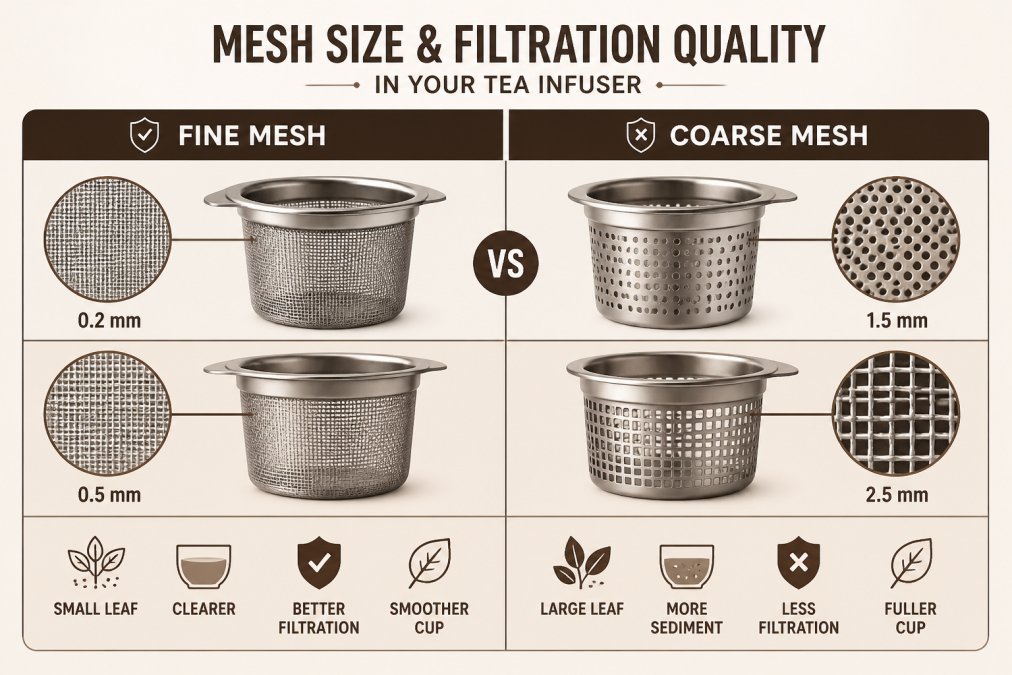
When considering the 7 features to look for in a tea infuser, the mesh size determines what gets through to your cup and what stays behind. A fine mesh catches broken leaves and dust particles, while a coarser mesh lets more sediment pass. This is the single most important feature when choosing a tea infuser, especially if you're brewing loose-leaf tea.
When mesh is too coarse, you'll end up with fine particles and leaf fragments clouding your brew and creating a grainy texture. A quality infuser uses a mesh basket with holes small enough to trap even the finest tea dust.
The filtration quality also affects how much aroma and flavor you get into your cup. Poor filtration forces you to use more tea leaves to compensate, which wastes product and increases your cost per cup. If fine particles escape, the mesh isn't tight enough for your needs.
Pros:
- Fine mesh prevents sediment and bitter leaf fragments
- Better water circulation with quality mesh design
- Reusable infusers eliminate paper filter waste
Cons:
- Finer mesh clogs more easily and requires thorough cleaning
- Some mesh materials stain over time with dark teas
2. Material Matters: Stainless Steel, Silicone, Glass, and Paper Options
Your infuser's material affects durability, heat resistance, flavor, and how long it lasts. Stainless steel is the most durable choice, it resists corrosion, handles boiling water without warping, and won't leach anything into your tea.
Stainless steel dominates for serious tea drinkers because it's food-contact safe, doesn't stain as easily as other metals, and lasts for years without degradation. If you're brewing multiple types of tea, from delicate jasmine to bold masala chai, stainless steel keeps each cup tasting clean.

Silicone offers convenience for travel and single-cup brewing. It collapses flat, fits inside mugs, and costs less than stainless options. The tradeoff is that silicone can absorb oils from tea leaves, potentially affecting future brews.
Material Comparison:
| Material | Heat Resistance | Durability | Best For | Maintenance |
|---|---|---|---|---|
| Stainless Steel | Excellent | 5+ years | Daily brewing, multiple tea types | Rinse and air dry |
| Silicone | Good | 2-3 years | Travel, single-cup use | Hand wash, air dry |
| Glass | Good | 3-4 years | Visual brewing, light teas | Hand wash carefully |
| Paper | N/A | Single use | Convenience, minimal cleanup | Compost after use |
3. Capacity and Room for Leaf Expansion
Loose-leaf tea needs space to expand and unfurl during steeping. If your infuser is too small or packed too tightly, leaves can't move freely, which limits water circulation and reduces flavor extraction. A good infuser gives leaves room to double or triple in size as they absorb water.
Most loose-leaf teas expand significantly when steeped. A compact infuser that seems full with dry leaves will choke the brewing process. Look for infusers with a basket capacity that lets you fill it only halfway with dry tea, this gives leaves the space they need to open up and release their full flavor profile.
The size of your infuser also determines how much tea you can brew at once. Single-cup infusers hold about 3-4 grams of tea, which brews one 8-12 ounce cup. Larger basket infusers can handle 6-8 grams for bigger mugs or small teapots. If you're brewing for multiple people, a larger capacity saves time and effort.
Pros:
- Proper capacity prevents bitter, over-steeped tea
- Leaves fully expand for complete flavor extraction
- Larger infusers brew multiple servings efficiently
Cons:
- Oversized infusers take up more space in your cup or mug
- Smaller infusers limit you to single servings
4. Best Tea Infuser for Loose Leaf Tea: Design and Compatibility
Not all infuser designs work equally well with every tea type. The shape and size of your tea leaves determine which infuser design performs best. Whole leaves need more vertical space to unfurl, while broken leaves and fannings work in tighter spaces. Compatibility between your infuser and your tea type directly affects how well the infuser functions.
A tea ball with a hinged clasp works well for broken leaves and fannings but restricts whole leaf expansion. A basket infuser gives leaves more room and works better with larger leaf pieces. Infuser bottles have built-in straining and are ideal for cold brewing and travel.
For whole-leaf teas like our Jasmine Tea or Earl Grey Tea, a basket infuser or infuser mug gives the best results. These designs let leaves move freely and water circulate completely. For finely chopped teas, a mesh ball or smaller basket works fine. The key is matching the infuser design to the actual leaf size and shape of the tea you're brewing.

Pros:
- Right design maximizes flavor extraction for your tea type
- Proper compatibility prevents leaf escape and sediment
- Design choice affects brewing convenience and cleanup
Cons:
- You may need multiple infuser types for different teas
- Some designs don't fit all cup and mug sizes
5. Tea Infuser Basket vs Tea Ball: Which Design Works Best
The choice between a basket infuser and a tea ball comes down to leaf size, brewing volume, and convenience. A tea ball is a hinged metal sphere that opens to hold tea leaves.
Tea balls are popular for travel because they're small and lightweight. They fit inside most mugs and cups without taking up much space. The downside is that leaves inside a tea ball are confined, which limits expansion and can lead to under-extraction.
Basket infusers are the choice for serious tea drinkers at home. They sit at the bottom of your cup or mug and let leaves spread out fully. Water can flow freely around all sides of the leaves, ensuring even steeping and complete flavor extraction.
If you're choosing between the two, consider how you'll use it most. For daily home brewing with loose-leaf tea, a basket infuser delivers better flavor. For occasional travel or single-serve brewing on the go, a tea ball offers convenience.
Pros of Basket Infusers:
- Larger capacity accommodates whole leaves
- Better water circulation and flavor extraction
- Easier to fill, steep, and clean
Pros of Tea Balls:
- Compact and portable
- Works in any cup size
- Lower cost for basic models
6. How Much Loose Leaf Tea Per Cup: Dosing and Brewing Performance
The amount of loose-leaf tea you use directly affects brew strength and flavor. A general guideline is 1 teaspoon (about 2-3 grams) of loose-leaf tea per 8-ounce cup of water. Some teas need more, some need less, depending on leaf size and desired strength.
Brewing performance depends on getting the dosage right. Too little tea produces a weak, watery cup with minimal flavor. Too much tea creates bitterness and astringency, especially with black teas and herbal blends.
Steeping time matters just as much as the amount of tea. Most loose-leaf teas steep for 5-10 minutes at the proper water temperature. Our Hibiscus Berry Tea steeps at 212°F for 5-10 minutes using 3 grams per 12 ounces.

If you're using an infuser that's too small, you might be tempted to cram more tea into it. Resist that urge. Overcrowding prevents proper water circulation and leads to uneven extraction. Better to use the right amount in a properly-sized infuser than to force too much tea into a cramped space.
Dosing Guide by Leaf Type:
| Tea Type | Amount Per 8 oz | Amount Per 12 oz | Steeping Time | Water Temperature |
|---|---|---|---|---|
| Whole Leaves | 1 tsp (3g) | 1.5 tsp (4.5g) | 5-10 min | 195-212°F |
| Broken Leaves | 0.75 tsp (2g) | 1 tsp (3g) | 5-8 min | 190-210°F |
| Fannings/Dust | 0.5 tsp (1.5g) | 0.75 tsp (2g) | 3-5 min | 185-205°F |
7. Tea Infuser Cleaning Tips and Long-Term Durability
How you clean your infuser determines how long it lasts and whether it retains stains or flavors from previous brews.
Stainless steel infusers are the easiest to maintain long-term. They resist staining better than other materials and won't absorb flavors. Rinse them thoroughly after each use and air dry.
Silicone infusers need careful cleaning because they absorb oils and odors. Hand wash only, dishwashers can degrade the silicone over time. Soak in hot soapy water to loosen dried tea particles, then rinse thoroughly.
Glass infusers require gentle handling. Hand wash only to avoid thermal shock from sudden temperature changes. Use a soft sponge and avoid abrasive scrubbers that can scratch the glass.
Durability depends on material quality and care. A stainless steel infuser with proper maintenance lasts 5+ years. Silicone typically lasts 2-3 years before it starts retaining flavors. Glass lasts 3-4 years if handled carefully.
Cleaning Best Practices:
- Rinse immediately after use while particles are wet
- Use a soft brush for mesh baskets
- Soak in vinegar monthly to remove mineral buildup
- Air dry completely before storing
- Replace silicone infusers every 2-3 years
- Discard glass infusers if cracks appear
Choosing the right tea infuser comes down to understanding the 7 features to look for in a tea infuser and matching them to your brewing style and the types of tea you enjoy. Mesh size determines filtration quality, material affects durability and heat resistance, and capacity gives leaves the room they need to expand. Design compatibility matters, a basket infuser works better for whole leaves than a tea ball does. Dosing and brewing performance improve when you use the right amount of tea at the proper temperature. Finally, cleaning and long-term durability depend on material choice and how you care for your infuser.
At Wild Mustang Roasters, we believe the best infuser is one you'll actually use every day.
Frequently Asked Questions
What type of tea infuser is best for loose-leaf tea?
A basket-style infuser with fine mesh (100-150 microns) works best for loose-leaf tea. It provides ample space for leaves to expand during steeping while preventing fine particles from escaping into your cup. Stainless steel baskets are durable and heat-resistant, making them ideal for repeated use with various tea types, from delicate florals like Jasmine Tea to robust blends like Masala Chai Tea.
How much loose leaf tea should I use per cup of water?
Use approximately 1 teaspoon (2.5-3 grams) of loose-leaf tea per 8 ounces of water as a starting point. Most premium teas, including Wild Mustang Roasters blends, recommend 2.5-3g per 12 oz. Adjust based on your taste preference and the tea type: delicate greens like Moroccan Mint Green Tea may need less, while bold teas like Earl Grey benefit from the full amount for optimal flavor extraction.
How fine should the mesh be in a tea infuser?
Mesh should be fine enough to catch leaf fragments and broken leaves but not so fine that it restricts water circulation. A mesh size of 100-150 microns is ideal for most loose-leaf teas. This prevents fine particles from clouding your cup while allowing full water contact with the leaves for complete flavor extraction and aroma release.
How do you clean a tea infuser properly?
Rinse your infuser immediately after use under warm running water to prevent tea oils from drying and staining. For stainless steel infusers, use a soft brush to gently remove trapped leaves. For stubborn stains, soak in a mixture of equal parts white vinegar and water for 30 minutes. Avoid abrasive scrubbers that can damage the mesh.