

Why Small Batch Coffee Tastes Less Bitter
What Is Small Batch Coffee Roasting
Small batch coffee roasting is the practice of roasting limited quantities of green coffee beans in controlled environments to develop consistent flavor profiles and reduce unwanted bitter compounds. Unlike mass production roasting, which prioritizes volume and speed, small batch roasting emphasizes precision, allowing roasters to monitor heat transfer, development time, and roast profile consistency with meticulous attention.
At Wild Mustang Roasters, we understand that small batch coffee tastes less bitter because each roast receives individualized attention. The smaller volume means beans roast more evenly, heat distributes uniformly through the batch, and roasters can intervene if temperatures spike or plateau unexpectedly. In mass production, beans on the outer edges experience higher temperatures than those in the center, creating uneven development that results in a mixture of flavors often read as bitter or harsh.

The roasting process involves carefully orchestrated temperature changes. Beans start green and dense. As heat penetrates, they expand, moisture evaporates, and chemical reactions begin. The Maillard reaction develops brown color and initial flavors. Later, the second crack signals deeper caramelization. Small batch roasters listen for these acoustic markers and adjust heat accordingly. Mass producers rely on timers and preset curves that assume all beans behave identically.
How Roast Profile Consistency Reduces Bitterness
Roast profile consistency directly determines whether a coffee tastes bright and clean or flat and bitter. A roast profile is the precise temperature curve over time, how quickly heat ramps, when it plateaus, and how long beans spend in the roaster. When profiles drift, bitterness emerges. Some beans enter the second crack early, developing excessive bitter compounds through over-roasting, while others stay light and sour. Small batch roasting eliminates this variance because roasters can monitor development time and heat transfer in real time, adjusting burner intensity or airflow to keep the batch on track.
Development Time and Heat Transfer Control
Development time is the period from first crack to the end of the roast, typically 1 to 3 minutes depending on roast level (peer-reviewed research). During this phase, chlorogenic acid breaks down into other compounds. If development happens too fast, bitter compounds concentrate. If too slowly, the coffee tastes underdeveloped and sour.
Small batch roasting allows precise control over development time because roasters can see temperature curves in real time and adjust heat input to slow or accelerate the rate of rise. This granular control is impossible in industrial settings where the roast profile is locked in before the batch enters the drum.
Heat transfer in small batches occurs through convection (hot air circulating around beans) and conduction (direct contact with the roaster drum). In smaller volumes, the ratio of surface area to mass favors more even heat distribution. Beans tumble freely, exposing all sides to moving air. In large batches, beans in the center sit in cooler microclimates, creating the uneven development that triggers bitterness.
Chlorogenic Acid and Bitter Compound Formation
Chlorogenic acid is the primary bitter-tasting compound in green coffee, comprising roughly 5-8% of the bean's dry weight (peer-reviewed research). As beans roast, chlorogenic acid breaks down through heat-driven chemical reactions, reducing the sharp, astringent bite many associate with poorly roasted coffee. However, this breakdown must happen gradually and evenly. If development time is too short, chlorogenic acid remains partially intact. If heat spikes suddenly, beans scorch before chlorogenic acid can fully degrade, trapping bitter compounds in the cellular structure. Small batch roasting prevents both scenarios by maintaining steady, predictable temperature curves.
The byproducts of chlorogenic acid breakdown include quinic acid and other compounds that contribute to the coffee's acidity, the bright, clean taste specialty coffee drinkers prize. When roasting is controlled, this acidity is pleasant and complex. When roasting is rushed or uneven, acidity becomes sharp and unpleasant, often masked by bitterness.
Best Brewing Methods to Reduce Bitterness
The roast profile sets the foundation, but brewing technique determines the final taste. Even a perfectly roasted coffee can taste bitter if brewed incorrectly. The most common culprit is over-extraction, pulling too much soluble material from the grounds into the cup.
Over-extraction happens when water contacts grounds for too long, at too high a temperature, or with too fine a grind. A French press brewed for 8 minutes instead of 4 will taste noticeably more bitter. The same coffee passed through a paper filter at 205°F instead of 195°F will taste harsher. Small batch coffee tastes less bitter partly because the roast is clean, but also because it pairs well with brewing methods that respect its delicate balance.

Grind Consistency and Extraction Yield
Grind size controls how quickly water extracts soluble material from the grounds. Finer grinds expose more surface area, accelerating extraction. Coarser grinds slow extraction. Consistency matters equally, if some particles are fine and others coarse, water extracts unevenly, with fine particles over-extracting and releasing bitter compounds.
A burr grinder (conical or flat) produces consistent particle sizes. Blade grinders create chaotic mixtures of dust and chunks, guaranteeing uneven extraction and bitter results. For small batch coffee, a quality burr grinder is essential. Wild Mustang Roasters recommends coarse grind options optimized for slow-extraction brewing methods like French presses, which naturally reduce bitterness by limiting contact time.
Extraction yield, the percentage of ground coffee that dissolves into the cup, sits in a sweet spot around 18-22% for most brewing methods. Below 18%, the coffee tastes sour and thin. Above 22%, it tastes bitter and harsh. A French press with a coarse grind and 4-minute steep hits this target naturally.
Water Temperature and Brewing Ratio
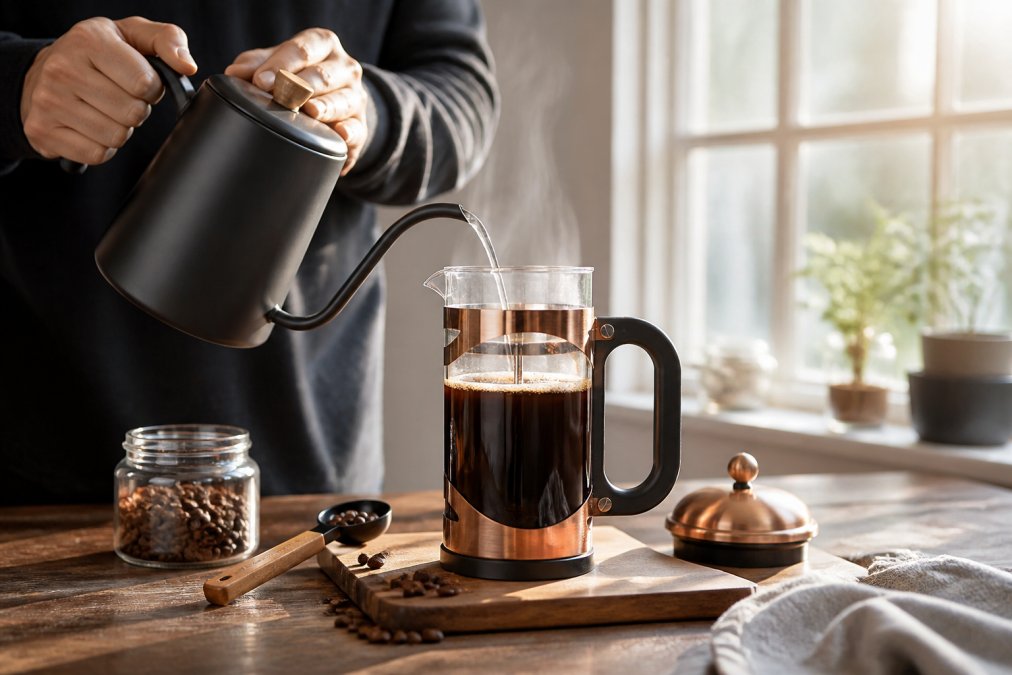
Water temperature directly affects extraction speed. At 212°F (boiling), extraction accelerates dramatically, often overshooting the 18-22% sweet spot and landing in bitter territory (peer-reviewed research). At 195°F, extraction proceeds at a measured pace, allowing desirable flavors to dissolve while bitter compounds lag behind.
Different brewing methods tolerate different temperatures. French presses work well at 195-200°F because the longer steep time compensates for slightly cooler water. Drip brewers often operate at 200-205°F because contact time is shorter. The key is matching temperature to method.
Brewing ratio, the weight of coffee to water, also influences bitterness. A ratio that's too high concentrates bitter compounds. A ratio that's too low over-extracts as water searches for enough soluble material. The standard ratio of 1:16 (one part coffee to sixteen parts water by weight) works for most methods. Small adjustments here prevent the bitterness that comes from pushing extraction too far.
How to Keep Coffee Beans Fresh Longer
Freshness is the third pillar of non-bitter coffee. Beans begin to stale the moment they're roasted, and oxidation accelerates this process. Old beans taste flat, hollow, and often bitter as oils oxidize into rancid or astringent compounds. Small batch coffee tastes less bitter partly because it's fresher when it reaches you, smaller roasters move inventory faster and often roast to order rather than stockpiling finished goods.
Storage conditions matter enormously. Beans exposed to light, heat, or air oxidize rapidly. The ideal storage is an airtight container, kept away from direct sunlight and heat sources, at a stable room temperature.
Oxidation and the Freshness Paradox
Beans need a few days after roasting to fully degas before they're at their peak. Immediately after roasting, beans release CO2 trapped inside their cellular structure, interfering with brewing and causing chaotic extraction. After 3-7 days, degassing slows, and beans reach their flavor window, typically 2-4 weeks from the roast date.
After that window closes, oxidation accelerates. The beans' oils and aromatic compounds break down, and the coffee tastes increasingly bitter, flat, and hollow. This is why roast date matters more than "best by" date. A coffee roasted 5 days ago will taste cleaner than one roasted 30 days ago, even if both are technically "fresh."
Small batch roasters often print the roast date on the bag, letting you buy beans at the right point in their lifecycle. Mass-produced coffee often hides the roast date or prints a vague "best by" date months away, leaving you unable to know if beans are 2 weeks or 2 months old.
Over-Extraction vs. Under-Extraction: Finding the Balance
The most common reason coffee tastes bitter is over-extraction, water pulls out too much soluble material, including harsh, astringent compounds. Under-extraction is rarer but equally problematic, leaving coffee tasting sour, thin, and underdeveloped.
Over-extracted coffee tastes bitter, dry, harsh, and sometimes burnt, with a lingering unpleasant aftertaste. Under-extracted coffee tastes sour, thin, and weak. The fix depends on which problem you're facing. For over-extraction: use cooler water, coarser grind, shorter brew time, or less coffee. For under-extraction: use hotter water, finer grind, longer brew time, or more coffee. Small batch coffee tastes less bitter because it starts with a clean roast profile, simple adjustments to brewing variables yield noticeable improvements.
A practical test: brew your coffee as you normally do, then brew the same beans with slightly cooler water and a coarser grind. If the second cup tastes cleaner and less bitter, you were over-extracting. If it tastes sour and thin, you were under-extracting and should adjust in the opposite direction.
Equipment Cleanliness and Thermal Stability
Coffee equipment accumulates oils and residue that oxidize into bitter, rancid-tasting compounds. A French press used daily but cleaned only occasionally develops a film of old coffee oil inside the glass that dissolves into fresh brews, adding a stale, bitter note unrelated to the beans themselves.
Thermal stability, the ability of brewing equipment to maintain consistent temperature throughout the brew, also affects bitterness. A thin-walled brewer loses heat rapidly, causing temperature to drop mid-brew and extraction to slow unevenly. A thick-walled brewer maintains temperature, ensuring consistent extraction.
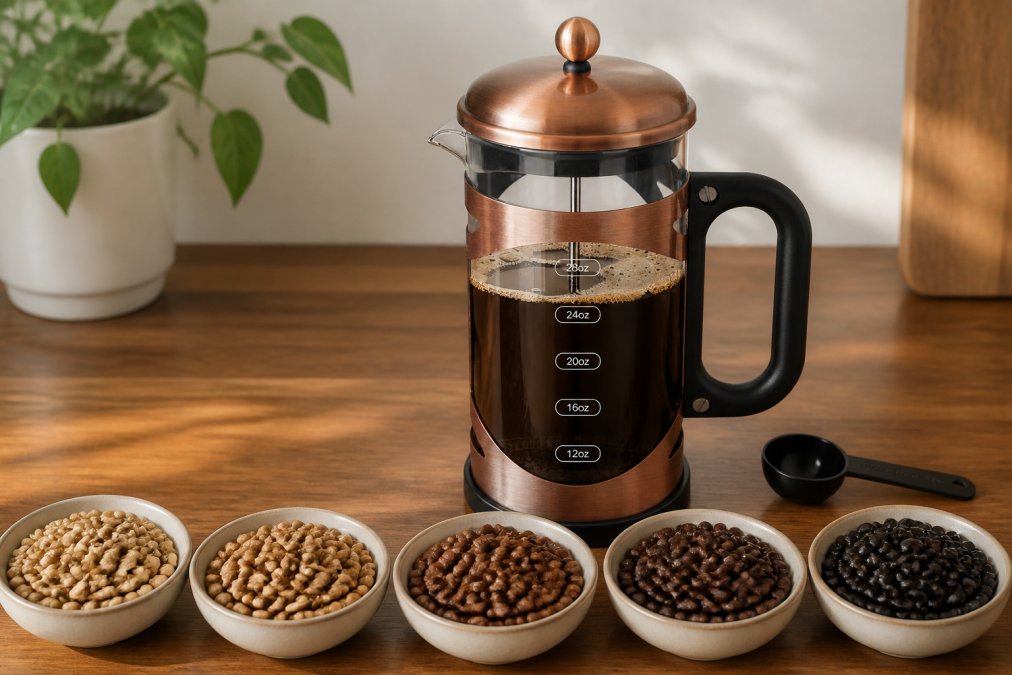
Wild Mustang Roasters' 34oz French Press uses borosilicate glass with stainless steel components, designed to maintain thermal stability throughout the brewing process. Regular cleaning, rinsing with hot water immediately after brewing and occasional deep cleaning with baking soda or vinegar, prevents oil buildup that would otherwise make every cup taste progressively more bitter.
| Cleaning Task | Frequency | Impact on Bitterness |
|---|---|---|
| Rinse with hot water | After every brew | Removes fresh grounds and prevents immediate oil buildup |
| Soak in baking soda solution | Weekly | Dissolves oxidized oils that cause stale, bitter taste |
| Vinegar rinse | Monthly | Removes mineral deposits that interfere with thermal stability |
| Replace seals/filters | Every 6-12 months | Prevents degraded rubber from leaching bitter compounds |
Small batch coffee tastes less bitter because of three interconnected factors: precise roast profiles that develop beans evenly, fresher beans that haven't oxidized into stale compounds, and the natural pairing with brewing methods that respect the coffee's delicate balance. When all three factors align, the result is coffee that's bright, clean, and free of the harsh bitterness that plagues mass-produced alternatives.
Wild Mustang Roasters' commitment to small-batch roasting means every bean receives the attention it deserves. Pair that foundation with our coarse grind options, a quality French press, and beans used within their flavor window, and you'll experience the difference that precision makes. Start with our Wild Mustang Sample Pack of 6 (Best Sellers) to explore multiple roast profiles, or try the Trailblazer Single-Origin Sample Pack to taste how origin influences bitterness. Combine either with our 34oz French Press for a complete brewing setup optimized to bring out the best in small batch coffee.

Frequently Asked Questions
How can I get my small batch coffee to taste less bitter?
Start by adjusting three variables: grind size (use a coarse grind for longer brewing), water temperature (aim for 195-205°F), and brewing ratio (typically 1:16 coffee to water). Small batch coffees have better roast profile consistency, which means they're less prone to over-extracted bitter compounds. Use freshly roasted beans within 2-4 weeks of the roast date, and ensure your equipment is clean, oil buildup creates stale, bitter flavors.
Does roast level affect how bitter small batch coffee tastes?
Yes, significantly. Small batch roasters control development time more precisely, preventing excessive chlorogenic acid breakdown that creates harsh bitterness. Light and medium roasts preserve more acidity and flavor clarity with fewer bitter compounds. Dark roasts naturally taste bolder but less bitter when roasted carefully. The key difference with small batch roasting is consistency, each bean reaches the same internal temperature at the same rate, avoiding the under-developed or over-roasted beans that mass production sometimes misses.
How long does small batch coffee stay fresh, and how do I store it?
Small batch coffee peaks in flavor 3-7 days after roasting and remains excellent for 2-4 weeks. Store beans in an airtight container away from light, heat, and moisture. Avoid the refrigerator, temperature fluctuations cause condensation and accelerate oxidation. The 'freshness paradox' is real: beans need 24-48 hours to degas after roasting before brewing, so the newest roasts aren't always the best. Check the roast date on your bag and plan to use beans within this window for optimal taste.
What brewing method works best to reduce bitterness in small batch coffee?
French press and pour-over methods give you the most control over extraction. French press uses immersion brewing with coarse grounds and lower water temperature, reducing over-extraction. Pour-over allows you to adjust water temperature and pour rate for precision. Both methods work better with small batch coffee because the consistent roast profile means even extraction across all grounds. Avoid over-brewing or using water hotter than 205°F, which pulls excessive tannins and bitter compounds.