

How to Identify Coffee Flavor Notes: A Beginner's Guide
Last Updated: October 23, 2026
Quick Summary
To identify coffee flavor notes, run a repeatable cupping protocol: smell the dry grounds, smell the wet grounds after breaking the crust at about 4:00, then slurp and taste again as the cup cools. Write one word per step, then use the coffee flavor wheel to narrow broad families like fruity into specific descriptors like dried orange.
- Use 8.25 grams of medium-ground coffee to 5 fluid ounces of water at around 200°F.
- Slurping sprays coffee across your palate and pushes aroma up behind your nose.
- Heat masks sweetness and aroma, so many notes only appear below about 140°F.
- Most experienced tasters land on two to four descriptors per coffee, not ten.
- Light roasts lead with floral, citrus, and berry notes and high acidity.
Table of Contents
- Why Coffee Tasting Notes Confuse Most Beginners
- Coffee Tasting Notes Explained: Perception, Not Added Flavor
- A Repeatable Tasting Protocol: Coffee Cupping for Beginners
- Using the Coffee Flavor Wheel to Move from Broad to Specific
- How Roast Level Affects Coffee Flavor
- Separating Flavor from Acidity, Bitterness, Body, and Aftertaste
- How Brewing Variables Change the Notes You Can Identify
- Calibration Exercises and a Tasting Worksheet for Practice
- Frequently Asked Questions
Why Coffee Tasting Notes Confuse Most Beginners
Coffee tasting notes confuse beginners because the words on the bag describe what you smell and taste, not what was added to the cup.
This guide from Wild Mustang Roasters breaks down how to identify coffee flavor notes step by step, using a repeatable tasting protocol, the coffee flavor wheel, and a simple worksheet.
Here is the first thing most guides get wrong: they treat tasting like a talent. It is a skill. And skills improve with practice, not luck.
Coffee Tasting Notes Explained: Perception, Not Added Flavor
Coffee tasting notes are the flavors your brain perceives when aroma, acidity, sweetness, and body combine in the cup. Nothing is added. No orange peel, no cocoa powder, no berry syrup. The flavors come from the coffee beans themselves. Single origin coffee flavor explains why origin matters.
Three things create those notes:
- Origin: soil, altitude, and climate shape what the plant produces
- Processing: washed, natural, and pulped natural methods shift the profile
- Roast level: heat develops some flavors and mutes others
So when a bag says "chocolate, cinnamon, green apple," it means trained tasters picked up those impressions. Your palate can learn the same language. It just needs the right starting point.
Specialty Coffee Association's flavor and cupping resources
A Repeatable Tasting Protocol: Coffee Cupping for Beginners
Coffee cupping for beginners is simple: smell the dry grounds, smell the wet grounds, slurp the coffee, then track how the flavor changes as the cup cools. Four steps, same order, every time.
Run this sequence with any coffee, and you will get comparable notes every time:
- Set up (0:00). Use a consistent ratio: 8.25 grams of medium-ground coffee to 5 fluid ounces of water, which is the standard cupping ratio most roasters use. Water should be just off a boil, around 200°F. Grind medium, roughly the texture of coarse sand.
- Dry aroma (0:00-0:30). Smell the grounds in the cup before water touches them. Write one word. Dry aroma tends to read flat and dusty; that is normal.
- Wet aroma (0:30-4:00). Pour the water to the rim and let the crust of grounds float. At about 4:00, break the crust with a spoon and smell directly over the cup. This is the strongest aroma moment of the whole session. Write one word.
- First sip (8:00-10:00). When the cup has cooled enough not to scald, slurp from a spoon. Slurping sprays coffee across your palate and pushes aroma up behind your nose, which is where most of what you call "flavor" actually happens. Write the flavor family first, then a specific descriptor only if it is clear.
- Mid-cool (12:00-15:00). Taste again. This is where sweetness and acidity usually separate. Note whether the cup got brighter, sweeter, or flatter.
- Room temperature (20:00+). Taste one last time. The finish is easiest to judge here: what lingers, and for how long.
Write one word per step and do not edit yourself yet. Volume beats polish when you are starting.
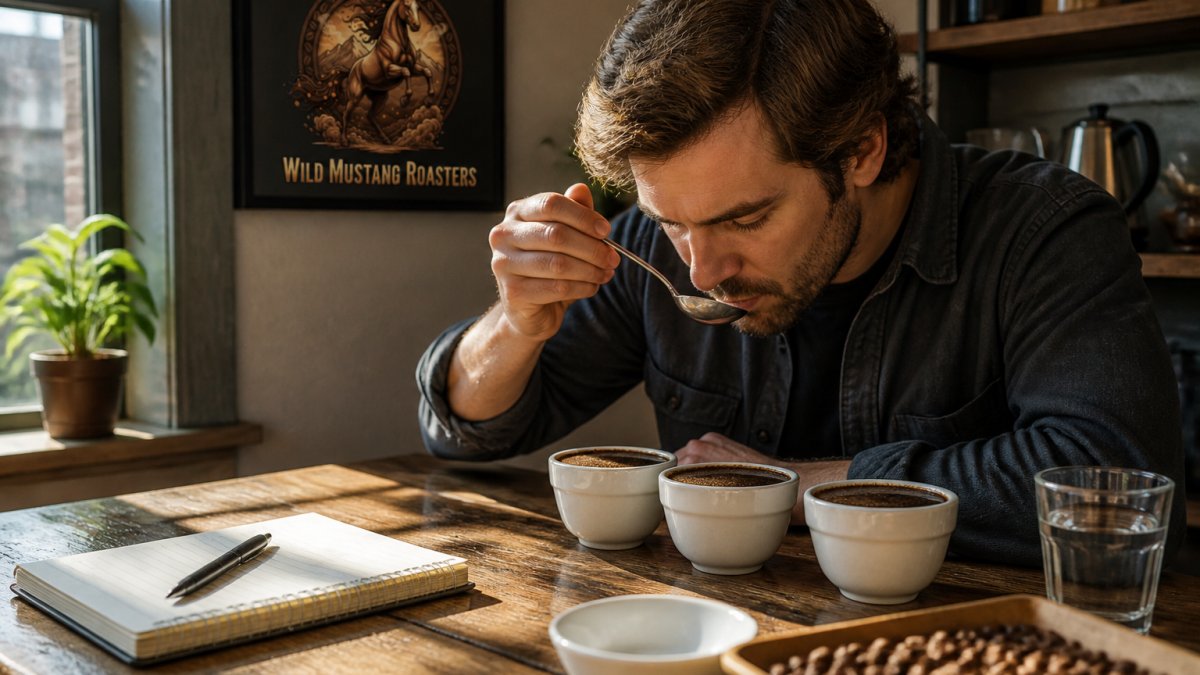
A common pattern among people learning to cup is that they skip the cooling steps because the hot cup feels like the "real" taste. It is not. The cooling curve is where most identifiable notes live, and it is the part of the protocol competitors tend to leave out.
Using the Coffee Flavor Wheel to Move from Broad to Specific
The coffee flavor wheel is a map that starts with broad families and narrows to specific descriptors.
The move looks like this:
- Fruity becomes citrus, berry, or dried fruit
- Citrus becomes orange, lemon, or grapefruit
- Orange becomes dried orange or fresh orange peel
That narrowing matters. "Fruity" is a family. "Dried orange" is a descriptor. The wheel gives you the ladder between them.
A practical habit: pick the family first, then get specific only if the note is clear. Forcing precision too early leads to guessing.
Here is a starter bank of descriptors by family, so you have words to reach for when a family clicks:
| Family | Sub-groups | Common descriptors |
|---|---|---|
| Fruity | Citrus, berry, dried fruit, stone fruit | Lemon, grapefruit, blueberry, strawberry, raisin, cherry, peach |
| Floral | Floral, tea-like | Jasmine, rose, chamomile, black tea |
| Sweet | Brown sugar, caramel | Caramel, toffee, honey, molasses, maple syrup |
| Nutty / cocoa | Nut, chocolate | Almond, hazelnut, milk chocolate, dark chocolate, cocoa nib |
| Spice | Brown spice, pungent | Cinnamon, clove, nutmeg, anise |
| Roasted | Roasted, smoky | Toast, char, smoke, tobacco |
| Sour / fermented | Sour, fermented | Yogurt, winey, overripe fruit |
A second habit that helps: use the wheel backward when you are stuck.
Specialty Coffee Association's flavor and cupping resources
How Roast Level Affects Coffee Flavor
Roast level affects coffee flavor by changing which notes lead the cup. Lighter roasts keep origin character and acidity up front. Darker roasts push toward cocoa, caramel, and molasses as the roast itself adds sweetness and depth.
Here is how it usually plays out:
| Roast Level | Typical Notes | Acidity |
|---|---|---|
| Light | Floral, citrus, berry, tea-like | High |
| Medium | Caramel, nut, milk chocolate, fruit | Balanced |
| Dark | Cocoa, molasses, brown sugar, smoke | Low |
Our own lineup shows this clearly. Wild Mustang's roast levels explained light to dark walks through each roast in the lineup. The Ethiopia single origin, a medium-light roast, reads with milk chocolate, fruity, and caramel notes.
Separating Flavor from Acidity, Bitterness, Body, and Aftertaste
Flavor is only one part of what you taste. Acidity, bitterness, body, and aftertaste are separate qualities, and mixing them up is the most common reason beginners mislabel a cup.
Here is the split:
- Acidity (brightness): the lively, juicy sensation. Not the same as sour or bad.
- Bitterness: a sharp, drying taste. Some is normal; too much points to brewing problems.
- Body (mouthfeel): how heavy the coffee feels. Thin and tea-like, or thick and syrupy.
- Aftertaste (finish): what lingers, and for how long.
A coffee can be bright and sweet with a clean finish, or low-acid and heavy with a long cocoa finish. Both are good. They are just different. Name each quality on its own before you try to describe the flavor as a whole.
Do not call a coffee "bitter" when it is actually bright. High acidity feels sharp at first sip, but it fades. Real bitterness sticks around and dries out your mouth. Confusing the two will send you chasing the wrong brewing fix.
How Brewing Variables Change the Notes You Can Identify
Brewing variables change the notes you can identify because extraction decides which compounds make it into the cup. Change the grind, water temperature, or brew time, and the same beans will taste different.
The variables that matter most:
- Grind size: finer pulls more out, coarser pulls less
- Water temperature: hotter water extracts faster and can pull bitterness
- Brew time: longer contact means more extraction
- Ratio: more coffee to water means a stronger, denser cup
Under-extracted coffee tastes sharp, thin, and sour, and the sweet notes never show up. If a bag promises caramel and you get nothing, check your brew before you blame the beans. How to brew coffee without bitterness covers the brew variables in more depth.
Our coarse grind options are built for slow-extraction brewing, which keeps the cup even and lets the sweeter notes come through.
Calibration Exercises and a Tasting Worksheet for Practice
Calibration is how you train your palate to match words to sensations. The fastest way is side-by-side tasting: two or three coffees at once, same brew method, notes written down for each.
Try these exercises:
- The triangle test: brew three cups, two the same and one different. Find the odd one out.
- The cooling test: taste one coffee at hot, warm, and room temperature. Note what changes.
- The family drill: pick one flavor family, then find it in three different coffees.
Use this worksheet for every tasting:
- Coffee name, origin, and roast level
- Dry aroma (one word)
- Wet aroma (one word)
- First sip: flavor family
- Specific descriptor, if clear
- Acidity: low / medium / high
- Body: thin / medium / heavy
- Finish: short / medium / long, and what lingers
- One sentence summary
A sample pack makes this easy. Best single origin coffee for beginners suggests concrete coffees to test your new skills on. The Wild Mustang Sample Pack of 6 gives you six coffees in 2 oz. packs, so you can cup them side by side and compare notes without committing to full bags.

Learning to identify coffee flavor notes takes repetition, not talent. Brew the same coffee twice, write down what you smell and taste, and compare. That habit does more than any single bag ever will.
Frequently Asked Questions
Do coffee tasting notes mean flavoring has been added?
No. Coffee flavor notes describe what your palate perceives, not ingredients added to the beans. A note of dried orange or berry comes from compounds created during roasting and fermentation, not from fruit or syrup. When a bag lists chocolate, caramel, or citrus, it is telling you what the coffee tastes like, not what was put into it. The next time you brew, compare the label to what you actually taste and smell; the match is the roaster's way of describing the bean's natural character.
How does roast level affect the flavor notes I can identify?
Roast level changes which notes are easiest to taste. Light and medium-light roasts keep more origin character, so fruity, floral, and citrus notes come through. Medium roasts balance sweetness with chocolate and nutty tones. Dark roasts push toward molasses, brown sugar, and dark chocolate while muting delicate fruit. If you want to practice identifying coffee flavor notes, start with a medium roast like a Colombia or Costa Rica, then try a dark roast to taste the shift. The difference teaches you how roast level affects coffee flavor.
How do you taste coffee to identify its flavor notes?
Use a simple three-step protocol. First, smell the dry grounds, then smell the wet slurry after adding hot water. Second, slurp a spoonful loudly to spread the coffee across your palate. Third, wait and note the finish. Write down the first three words that come to mind, even if they seem odd. Compare those words to a coffee flavor wheel to refine them. Repeat with the same coffee on different days; your vocabulary sharpens with practice.
How does brewing method affect the flavors you notice in coffee?
Brewing method changes extraction, which changes which notes dominate. A pour-over tends to highlight clarity and acidity, making citrus and floral notes easier to spot. A French press keeps more oils and sediment, so body and chocolate notes feel heavier. Espresso concentrates flavors and can make sweetness and caramel more intense. If a coffee tastes flat, try a different method before blaming the beans. Adjusting grind size and water temperature also shifts what you taste.
