

How to Brew Loose Leaf Tea Without an Infuser
Last Updated: October 26, 2026
Quick Summary
You can brew loose leaf tea without an infuser by pouring hot water directly over loose leaves in a mug, then pouring the brewed tea into a second vessel to separate the leaves. A French press, fine-mesh sieve, or paper coffee filter also work well to brew loose leaf tea using items you likely have at home.
- Use approximately one teaspoon of loose leaf tea per six to eight ounces of water as your standard ratio.
- Water temperature ranges from 160-185°F for white tea to 195-212°F for black tea and herbal tea.
- A fine-mesh sieve provides the best clarity, a French press offers the fastest separation, and paper coffee filters remove the most sediment.
- Steep times range from 2-4 minutes for white tea to 5-7 minutes for herbal tea depending on type.
- Pour slowly and tilt your mug just enough for liquid to flow while keeping leaves settled at the bottom.
Table of Contents
- Why Brew Loose Leaf Tea Without an Infuser
- How to Make Loose Leaf Tea in a Mug
- Brew Loose Leaf Tea with a French Press
- How Much Loose Leaf Tea Per Cup
- Loose Leaf Tea Steeping Time and Temperature
-
Alternative Straining Methods
- 1. Fine-mesh kitchen sieve (best overall clarity and control)
- 2. Coffee press (best for speed and hands-off separation)
- 3. Paper coffee filter (best for a sediment-free cup)
- 4. Disposable or biodegradable tea filter bags (best for portability)
- 5. Cheesecloth (best emergency option)
- 6. Decanting only (no strainer at all)
- Common Mistakes to Avoid When Brewing Without an Infuser
- Start Brewing Your Next Cup
- Frequently Asked Questions
Why Brew Loose Leaf Tea Without an Infuser
Brewing loose leaf tea doesn't require special equipment. You can brew loose leaf tea in almost any vessel you already have at home.
At Wild Mustang Roasters, we believe great tea should be accessible to everyone, wherever you brew.
Brewing without an infuser lets you control steeping time and water temperature, no special gadgets required.
How to Make Loose Leaf Tea in a Mug
The simplest way to brew loose leaf tea without an infuser is directly in your mug. Pour hot water over loose leaves and let them steep. When the tea reaches your desired strength, pour it into another cup to separate the leaves from the brewed tea.
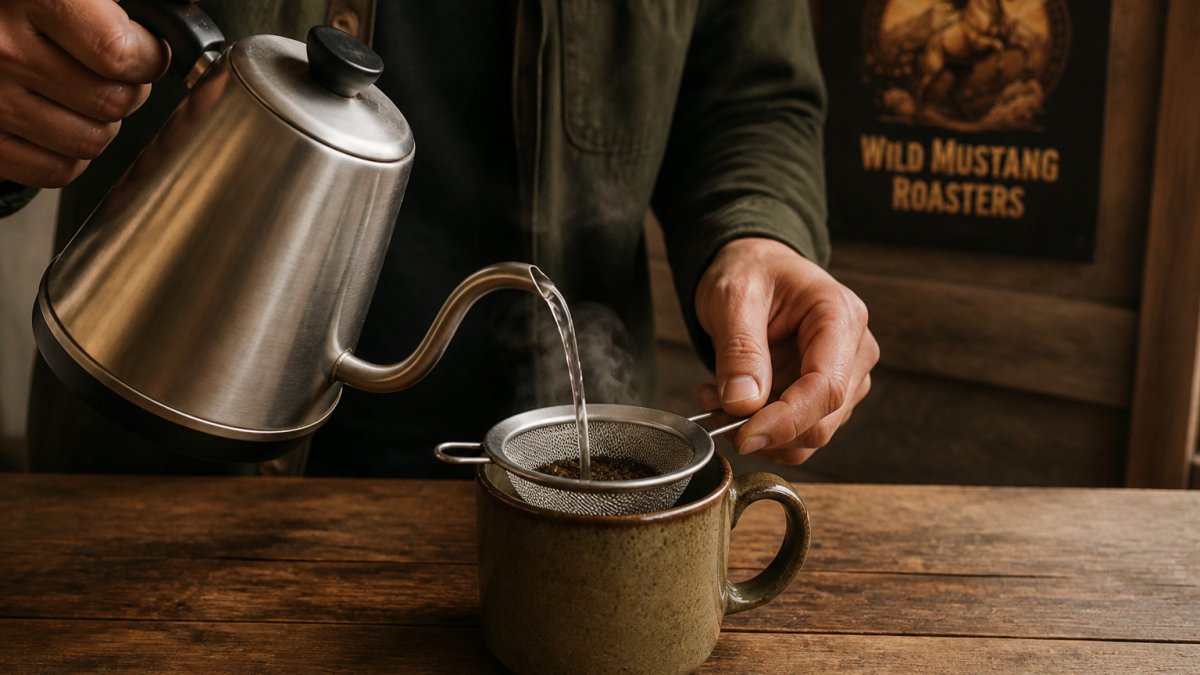
Here's the basic process:
- Add loose leaf tea directly to your mug (see the section on tea-to-water ratios below for exact amounts)
- Pour hot water at the correct temperature for your tea type
- Let it steep for the recommended time
- Pour the brewed tea into a second mug or cup, leaving the leaves behind
- Drink and enjoy
The key is having a second vessel ready to pour into once steeping is complete. A steady hand and a second mug are all you need.
Watch out: pouring too quickly or tilting the mug too far lets loose leaves escape into your cup. Tilt just enough for the liquid to flow while keeping the leaves settled at the bottom.
Brew Loose Leaf Tea with a French Press
A French press is one of the best alternatives for brewing loose leaf tea without a dedicated tea infuser. If you have a coffee press at home, you already own an excellent tea brewing tool: its mesh filter separates steeped leaves from brewed tea.
The 34oz French Press from Wild Mustang Roasters is made with borosilicate glass and comes with spare filter screens.

Here's how to brew loose leaf tea with a French press:
- Add loose leaf tea to the empty press (use the tea-to-water ratio guide below)
- Pour hot water over the leaves
- Place the lid on top without pressing down
- Let the tea steep for your desired time
- Slowly press the plunger down to separate leaves from brewed tea
- Pour into your cup immediately after pressing
How Much Loose Leaf Tea Per Cup
Getting the tea-to-water ratio right transforms your brewing experience: too little tea tastes weak, too much turns bitter and harsh. The standard ratio is approximately one teaspoon of loose leaf tea per six to eight ounces of water.
Here's a practical guide for common serving sizes:
| Serving Size | Loose Leaf Tea Amount | Water Temperature | Steeping Time |
|---|---|---|---|
| 6 oz cup | 1 teaspoon (about 2g) | 160-195°F | 3-5 minutes |
| 8 oz mug | 1.5 teaspoons (about 3g) | 160-195°F | 4-6 minutes |
| 12 oz travel mug | 2 teaspoons (about 4g) | 160-195°F | 5-7 minutes |
| Larger pot (20 oz) | 3 teaspoons (about 6g) | 160-195°F | 6-8 minutes |
This ratio is a starting point. For stronger tea, add another half teaspoon; for lighter tea, use slightly less.
A heaping teaspoon generally holds more leaf material than a level teaspoon, so be mindful of how you measure. For precision, a kitchen scale works best, most loose leaf tea weighs about two grams per teaspoon. Our Earl Grey Tea and Jasmine Tea from Wild Mustang Roasters can help you dial in your cup.


Loose Leaf Tea Steeping Time and Temperature
| Tea type | Water temperature | Steeping time | What happens if you go too hot or too long |
|---|---|---|---|
| White tea | 160-185°F | 2-4 minutes | Boiling water makes delicate white tea taste dull and hay-like |
| Green tea | 160-180°F | 2-3 minutes | Hot water pulls out harsh, astringent notes |
| Oolong tea | 185-205°F | 3-5 minutes | Over-steeping turns floral oolong heavy and bitter |
| Black tea | 195-212°F | 3-5 minutes | Too long makes black tea tannic and drying |
| Herbal tea (tisane) | 200-212°F | 5-7 minutes | Cooler water under-extracts roots, bark, and dried fruit |
These ranges assume a standard leaf-to-water ratio of about one teaspoon (roughly 2 grams) per 6 to 8 ounces of water. If you use more leaf, shorten the steep; if you use less, lengthen it slightly.
Why temperature matters
Hot water extracts tea compounds faster, and boiling water pulls out harsh, bitter compounds along with desirable flavor, which is why delicate green and white teas taste better at lower temperatures. Cooler water extracts more gently, preserving floral and fruity notes. Time and temperature work together: cooler water needs more time, hotter water needs less.
How to judge water temperature without a thermometer
A thermometer is the most accurate tool, but you can get close with a kettle and a little timing:
- Boiling (212°F): Water is at a rolling boil with large, vigorous bubbles.
- Around 195-205°F: Let boiling water rest 1 to 2 minutes; small bubbles still rise steadily.
- Around 180-190°F: Let boiling water rest 3 to 4 minutes; steam rises but the water is no longer bubbling.
- Around 160-175°F: Let boiling water rest 5 to 8 minutes; steam is faint and the surface is still.
Adjusting for taste
Start at the lower end of the time range, taste, and add 30 seconds at a time until the cup suits you. If it tastes bitter, use cooler water or a shorter steep, not more tea; if it tastes weak, try a longer steep before adding more leaf.
Alternative Straining Methods
If you don't want to pour mug-to-mug or use a French press, several household items separate leaves from brewed tea. They are not equal; below they are ranked by clarity, cleanup effort, and how well they handle fine particles and dust.
1. Fine-mesh kitchen sieve (best overall clarity and control)
A fine-mesh sieve is the most reliable improvised strainer. Set it over your serving cup, pour the brewed tea through slowly, and the mesh catches whole leaves and most broken pieces. Choose a mesh fine enough to hold back tea dust; a coarse kitchen sieve lets sediment through.
- Clarity: High. It removes whole leaves and most fragments.
- Cleanup: Rinse the sieve under hot water and tap out the leaves; most tea leaves compost easily.
- Trade-off: Very fine dust can still pass through, and you need a steady pour so the sieve doesn't overflow.
2. Coffee press (best for speed and hands-off separation)
A French press or coffee press uses a metal mesh plunger to trap leaves at the bottom. Add tea, pour hot water, steep, then press slowly and pour immediately. The mesh catches most leaf material, and because the plunger separates everything at once, you don't need a second vessel.
- Clarity: High for whole-leaf tea; moderate for fine-cut tea, which can slip past the mesh.
- Cleanup: The spent leaves come out in one mass, but the press needs a thorough rinse so old tea oils don't flavor the next cup.
- Trade-off: Fine particles and dust can pass through the screen, and pressing too fast forces sediment into the cup.
3. Paper coffee filter (best for a sediment-free cup)
Line a small strainer or funnel with a paper coffee filter and pour the brewed tea through it. The paper catches even tiny particles, producing the clearest cup of any method here.
- Clarity: Highest. It removes dust and fine sediment that mesh misses.
- Cleanup: Throw the filter and leaves away together; no rinsing required.
- Trade-off: Gravity draining is slow, the filter can tear if you pour too fast, and paper filters are disposable rather than reusable.
4. Disposable or biodegradable tea filter bags (best for portability)
Fill an empty filter bag with loose leaf tea, seal it, and steep it like a tea bag. This gives you the convenience of a bag with the leaf quality of loose tea.
- Clarity: High, because the bag material holds the leaves.
- Cleanup: Lift out the bag and discard it; almost no rinsing.
- Trade-off: You lose some control over leaf expansion, and disposable bags create ongoing waste and cost.
5. Cheesecloth (best emergency option)
Fold cheesecloth into a pouch, add tea, tie it closed, and steep. It works when nothing else is available, but the weave is loose and inconsistent.
- Clarity: Moderate to low; fine particles escape through the weave.
- Cleanup: Rinse and dry the cloth, or discard a used piece.
- Trade-off: Less precise than a bag or sieve, and the cloth can retain flavors if not washed thoroughly.
6. Decanting only (no strainer at all)
Pour the brewed tea slowly into a second mug, leaving the leaves settled at the bottom of the first. This requires no equipment beyond two mugs.
- Clarity: Moderate; whole leaves stay behind, but dust and small fragments often pour over.
- Cleanup: Rinse the brewing mug and knock the leaves into compost.
- Trade-off: It depends on a slow, steady pour and works best with large whole-leaf teas, not fine-cut or dusty teas.
Common Mistakes to Avoid When Brewing Without an Infuser
Finally, avoid reusing loose leaves without rinsing them first: a quick rinse with hot water removes the dust and debris that settles during the first brewing.
Start Brewing Your Next Cup
Brewing loose leaf tea without an infuser is straightforward once you understand the basics: hot water at the right temperature, the right amount of loose leaf tea, proper steeping time, and a way to separate the leaves from the brewed tea.
Wild Mustang Roasters offers loose leaf teas. Our Earl Grey Tea and Jasmine Tea are options to explore. Explore our tea collection.
Frequently Asked Questions
Can I brew loose leaf tea directly in a mug?
Yes. Pour loose leaves into your mug, add hot water, and steep for the recommended time. Once brewed to your taste, carefully pour the tea into another cup, leaving the leaves behind, or use a fine-mesh strainer to catch them as you pour. This works best with larger leaf varieties that settle quickly, and it's the simplest method when you don't have an infuser on hand.
How much loose leaf tea should I use per cup?
Wild Mustang Roasters' Earl Grey Tea lists 2.5 grams per 12 ounces of water.
How long should loose leaf tea steep?
Wild Mustang Roasters' Earl Grey Tea lists a steeping time of 5 to 10 minutes at 195°F.
Can I use a coffee press to brew loose leaf tea?
The Wild Mustang Roasters 34oz French Press serves around 5 to 6 standard 5oz cups and comes with two spare filter screens.
Start with the brewing method that fits your lifestyle. Master the fundamentals, water temperature, tea-to-water ratio, and steeping time, and you'll brew exceptional loose leaf tea every time, infuser or not.
