

Does Freezing Coffee Beans Affect the Flavor
Table of Contents
- Does Freezing Coffee Beans Actually Change the Taste
- How Freezing Preserves Coffee Freshness and Quality
- How to Freeze Coffee Beans the Right Way
- How Long Coffee Beans Last in the Freezer
- Freezing Coffee Beans in the Original Bag
- Freezer vs Refrigerator for Coffee Bean Storage
- Whole Beans Versus Ground Coffee: Which Freezes Better
- The Thaw and Brew Process: Protecting Flavor
- Frequently Asked Questions
Last Updated: October 19, 2026
Does Freezing Coffee Beans Actually Change the Taste
The short answer: does freezing coffee beans affect the flavor? Yes, freezing slows flavor loss but won't restore stale beans or match fresh-roasted taste.
Freezing pauses flavor degradation. Coffee beans contain volatile compounds that break down through oxidation, and cold temperatures slow this dramatically.
When frozen coffee beans thaw, condensation forms on the surface, extracting unwanted compounds and dulling bright flavors.
How Freezing Preserves Coffee Freshness and Quality
Freezing slows oxidation, the chemical reaction that degrades coffee flavor. At room temperature, beans lose their bright, aromatic qualities within two to three weeks of opening; in a freezer, this process slows significantly.
Cold temperatures reduce molecular movement, so the volatile compounds that give coffee its complexity stay intact longer. Understanding how does freezing coffee beans affect the flavor shows that cold temperatures preserve aromatic compounds more effectively than room-temperature storage.
But freezing buys time, not immortality. Even frozen beans degrade slowly. A properly frozen bag holds acceptable flavor for three to four months; beyond that, the taste shifts toward flat and muted.
Freezing pays off when you have more coffee than you can drink quickly.
How to Freeze Coffee Beans the Right Way
Airtight Packaging and Moisture Control
The enemy of frozen coffee is moisture.
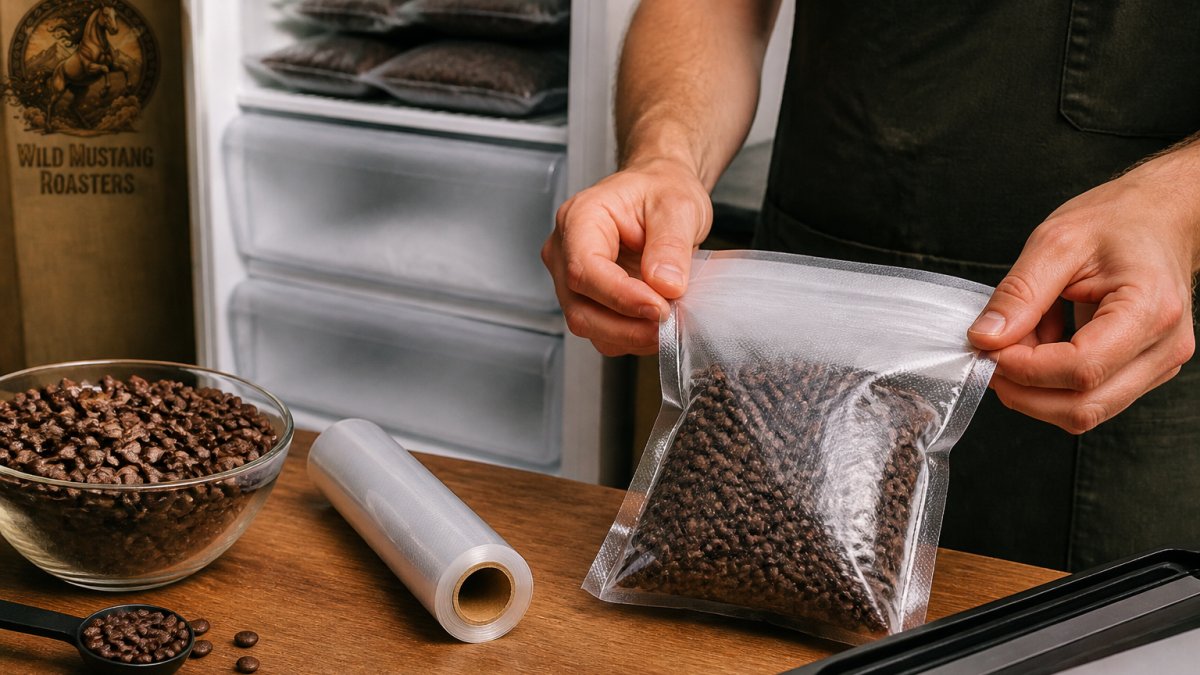
The solution is airtight packaging. Use vacuum-sealed freezer bags or airtight containers designed for long-term storage. Remove as much air as possible before sealing.
If you're using the original coffee bag, check for a one-way valve.
Label everything with the roast date. A bag that sat on a shelf two weeks before freezing won't taste the same as one frozen the day it arrived.
Portioning Beans Into Single-Use Batches
Freezing an entire bag and thawing it repeatedly is a mistake. Every freeze-thaw cycle introduces moisture and damages the beans slightly. The solution is portioning.
Divide your coffee into smaller bags before freezing, each enough for one to two weeks of brewing.
Use small freezer bags or vacuum-seal portions, and label each with the roast date and freeze date so you know exactly how long the beans have been frozen.
How Long Coffee Beans Last in the Freezer
Most guides answer this with a single number, which is misleading. Frozen coffee has a flavor curve and a separate safety question; understanding both tells you when it's still worth brewing.
Flavor degradation over time
Properly sealed whole beans frozen at 0°F or below follow a predictable pattern:
- Months 0-2: Peak quality. Aroma, acidity, and sweetness are close to what you would taste from a freshly opened bag. This is the window to use if you want the coffee to taste like it did when you bought it.
- Months 2-4: Still good, but the brightest notes soften. Fruit and floral aromas fade first; chocolate and nutty notes hold longer. Most drinkers find this range acceptable for everyday brewing.
- Months 4-6: Noticeable flattening. The cup tastes one-dimensional, acidity drops, and the finish can turn slightly woody. Acceptable for milk drinks or cold brew, less so for pour-over.
These windows assume the beans were frozen within a week or two of roasting and sealed airtight. Beans frozen later start further down the curve and will hit each stage sooner.
Food safety versus flavor
Freezing doesn't kill bacteria but stops their growth. Properly frozen coffee beans pose no food-safety risk like meat or dairy does, because coffee is dry with low water activity. The real risk is moisture intrusion from a poor seal or repeated thawing, which can support mold once the beans warm. If you see mold, smell a musty odor, or find clumps from condensation, discard the portion.
Short-term versus long-term storage
- Short-term (under 3 weeks): You do not need the freezer. An airtight container at room temperature preserves coffee well enough for most households.
- Medium-term (3 weeks to 3 months): The freezer earns its keep. Portion, seal, and thaw carefully, and you will taste a clear difference versus room-temperature storage.
- Long-term (3 to 6 months): Freeze only if you bought in bulk or want to hold a special bag. Expect some flavor loss and plan to use the coffee in milk drinks or cold brew.
Ground coffee and opened bags
Ground coffee degrades faster in the freezer due to greater surface area, plan on one to two months, not three to four. Opened bags resealed with a clip or fold aren't airtight enough for long-term freezing; transfer to a vacuum-sealed bag or hard-sided airtight container first.
A practical decision rule
Label every portion with the roast and freeze dates. Within two months, brew normally. Between two and four months, brew a small cup and taste before committing a full batch. Past four months, use it for cold brew or baking rather than a method that highlights origin flavors.
Freezing Coffee Beans in the Original Bag
Many specialty coffee bags look great on the shelf but aren't designed for freezing.
Coffee bags with one-way valves are most common. These valves let CO2 escape after roasting but don't seal airtight, so moisture seeps in during thawing.
Some premium bags use thick foil and ziplock seals.
The original bag works fine if you'll use the coffee within two to three weeks. For longer storage, transfer to airtight packaging.
Freezer vs Refrigerator for Coffee Bean Storage
Freezing is superior to refrigeration for coffee beans. The refrigerator is too warm and too humid.
Refrigerators sit around 40°F, which slows oxidation but not as effectively as freezing at 0°F or below.
A freezer at 0°F or colder slows oxidation dramatically.
Room temperature is the worst option for long-term storage.
Here's the practical breakdown:
| Storage Method | Temperature | Best For | Duration |
|---|---|---|---|
| Room temperature, sealed | 68-72°F | Short-term (1-3 weeks) | 2-3 weeks |
| Refrigerator, airtight | 40°F | Not recommended | 3-4 weeks |
| Freezer, airtight | 0°F or below | Long-term storage | 3-4 months |
The freezer wins if you need to store coffee beyond three weeks.
Whole Beans Versus Ground Coffee: Which Freezes Better
Whole beans freeze better than ground coffee. The difference is surface area.
Whole beans have a protective outer layer that slows oxidation.
If you freeze ground coffee, use it within one to two months. The flavor degrades faster than whole beans.
The best practice is to buy whole beans and grind them just before brewing. If you must freeze ground coffee, portion it carefully and use it quickly.
The Thaw and Brew Process: Protecting Flavor
How you thaw frozen coffee determines whether you taste the beans you paid for or a muted, slightly bitter version. The goal: get the beans from freezer temperature to room temperature without letting moisture condense on their surface.
Why condensation is the real enemy
When you pull a bag of beans from a 0°F freezer, room-temperature air holds moisture that condenses on the coldest surface it can find, the beans. The water dissolves oils and aromatic compounds on the bean surface and carries them away, and introduces moisture into the bean's cellular structure that can accelerate staling once it warms. The fix is not to thaw faster; keep the beans sealed until they reach room temperature so condensation forms on the packaging, not the coffee.
A repeatable freeze-thaw workflow
- Portion before freezing. Divide beans into single-use portions (enough for one to two weeks of brewing) and seal each portion airtight. Label with roast date and freeze date.
- Freeze flat and undisturbed. Lay portions flat so they freeze quickly and evenly. Avoid stacking heavy items on top, which can crack seals.
- Pull one portion at a time. Remove only the portion you plan to use. Leave the rest in the freezer.
- Thaw sealed, not open. Leave the sealed portion on the counter for 30 to 45 minutes, or overnight in the refrigerator for the lowest-condensation result. Do not open the bag during thawing.
- Open only at room temperature. Once the bag feels neutral to the touch (no cold sweat on the outside), open it. If you open a cold bag, you will see condensation form on the beans within seconds.
- Grind immediately and brew. Grind only what you will brew in the next few minutes. Thawed beans oxidize faster than room-temperature beans that were never frozen, so treat the thawed portion as a short window.
- Do not refreeze. Any portion you thaw should be used within its planned window. Refreezing introduces a second condensation cycle and guarantees flavor loss.
What this workflow protects, and what it cannot
A careful freeze-thaw preserves the volatile aromatic compounds that give coffee its fruit, floral, and caramel notes, slowing oxidation and limiting moisture damage. What it cannot do is restore beans that were already stale before freezing or undo damage from a poor seal. If beans went into the freezer three weeks after roasting and sat in a valve bag, no thaw technique will bring back the brightness they lost.
A transparent tasting method
To judge whether your freezing routine is working, brew two cups side by side: one from a freshly opened bag stored at room temperature, and one from a portion frozen on the same day the bag was opened and thawed using the workflow above. Use the same dose, grind setting, water temperature, and brew time. Compare four things:
- Aroma: Does the frozen-and-thawed cup smell as sweet and complex, or flatter?
- Acidity: Is the brightness intact, or does it taste dull and chalky?
- Bitterness: Does the finish turn harsh or woody, a common sign of moisture damage?
Most practitioners find a properly sealed, properly thawed portion holds up well for the first two to three months, with noticeable flattening after that. If your side-by-side shows a large gap, the problem is almost always packaging or thawing, not the freezer itself.
Frequently Asked Questions
Can you refreeze coffee beans after thawing them?
Refreezing is not recommended. Each freeze-thaw cycle exposes beans to temperature fluctuations and condensation, which degrades flavor and aroma. Instead, portion your freezing coffee beans into small batches you'll use within one brewing session. This approach eliminates the need to refreeze and keeps volatile compounds intact for better taste.
How long will coffee beans stay fresh in the freezer?
Properly sealed whole beans can maintain quality for 3-4 months in the freezer, though peak flavor is strongest in the first 4-6 weeks. Ground coffee degrades faster, typically staying fresh for 2-3 months. Use an airtight, moisture-resistant container to prevent oxidation and freezer odors from affecting your coffee. Check the roast date on the package to know how fresh your beans were when frozen.
Does freezing coffee beans change their taste?
When done correctly, freezing has minimal impact on flavor. The cold slows oxidation and preserves volatile compounds that create aroma and taste. However, improper storage, such as freezing in the original bag without sealing or allowing repeated temperature changes, can cause flavor loss and bitterness. The key is airtight packaging and consistent freezer temperature. Many coffee enthusiasts report that properly frozen beans taste nearly identical to fresh ones when brewed within the first month.
Should coffee beans be thawed before grinding?
Yes, thaw beans at room temperature for 10-15 minutes before grinding. Grinding cold beans can cause moisture condensation inside your grinder, which damages equipment and affects grind consistency. Allow frozen beans to reach room temperature gradually in their sealed container to prevent condensation on the bean surface. Once thawed, grind immediately for the best flavor and brew right away for optimal taste.